


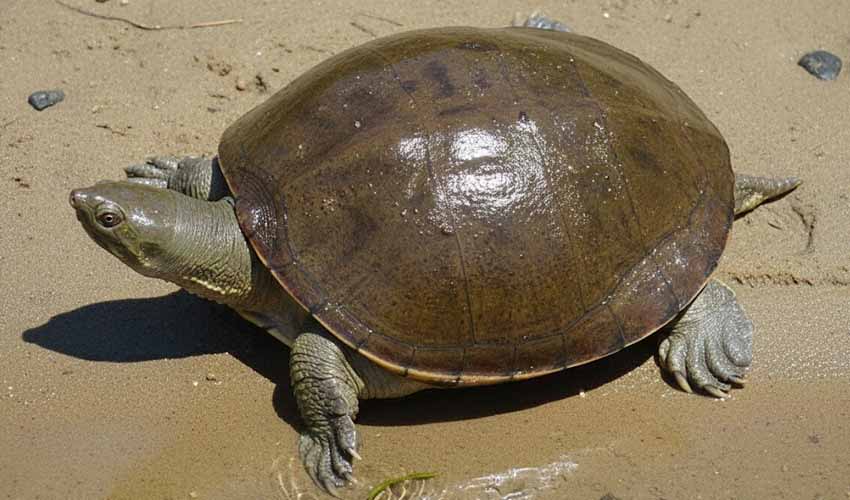
A freshwater turtle from Myanmar and nearby areas that looks like a classic turtle—until you notice the shell doesn’t feel “classic” at all. Instead of being hard and boxy, its shell is flatter and more flexible, like tough leather stretched over a frame. That design makes it a strong swimmer and an excellent “disappearing act” specialist in muddy rivers and wetlands. It also has the feature that gives flapshell turtles their name: soft, hinged flaps along the underside that fold inward to help cover the legs and other vulnerable parts when the turtle pulls in tight.
Burmese flapshells are closely tied to the big river systems of Myanmar—particularly the Irrawaddy and Salween basins—while the Indian flapshell lives much farther west across South Asia. If you’re looking at the turtle itself, Burmese flapshells often show an olive-brown to brown top shell. Young ones may have darker spots, while adults can develop a more net-like, fine pattern that can look like faint scribbles or a delicate maze. The head is usually olive to brown, and it commonly carries soft, shadowy stripes—one trailing back from each eye and another running between the eyes—more like smudged paint than sharp lines.
Rather than spending lots of time perched in the open, it often rests in shallow water or partly buried in the bottom, with only the eyes and nose showing. That nose is not just for looks—it helps the turtle breathe with minimal movement, so it can wait out danger and watch for food. When it decides to move, it can slide off like a living shadow, kicking with strong, webbed feet and using its flexible shell to squeeze through weeds and tight spaces. It feeds mainly on aquatic prey—especially fish and other small water animals—and it doesn’t need a dramatic chase; a quick lunge is usually enough when it’s already positioned in the perfect ambush spot.
Distribution
 Myanmar
Anything we've missed?
Help us improve this page by suggesting edits. Glory never dies!
Suggest an editGet to know me
Terrestrial / Aquatic
Altricial / Precocial
Polygamous / Monogamous
Dimorphic (size) / Monomorphic
Active: Diurnal / Nocturnal
Social behavior: Solitary / Pack / Herd
Diet: Carnivore / Herbivore / Omnivore / Piscivorous / Insectivore
Migratory: Yes / No
Domesticated: Yes / No
Dangerous: Yes / No




