


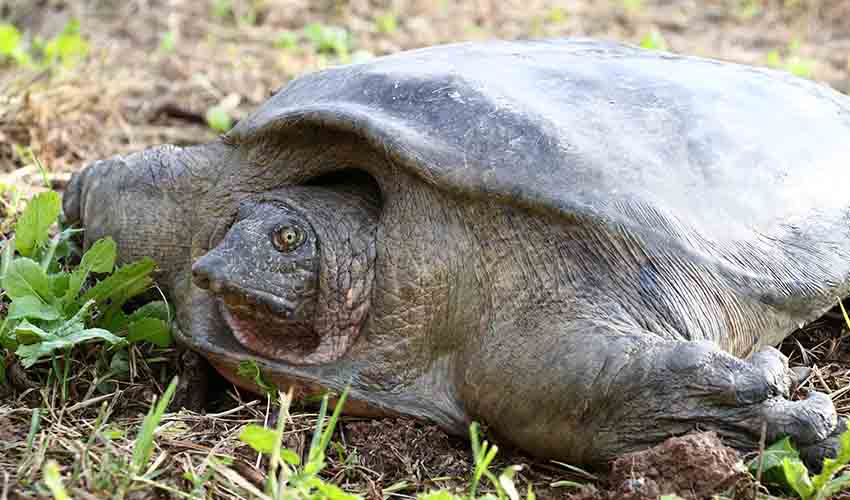
Found mainly in the Euphrates and Tigris river systems of Turkey, Syria, Iraq, and parts of Iran, it lives in large, slow-moving rivers, canals, lakes, and marshes. Unlike the familiar hard-shelled turtles many people imagine, this species belongs to the softshell group, meaning its shell is flat, flexible, and covered with tough leathery skin rather than hard plates. Its body is broad and pancake-shaped, perfectly designed for gliding through water with little resistance.
One of the most distinctive traits of the Euphrates softshell turtle is its large size. It is among the biggest softshell turtles on Earth, with adults sometimes reaching more than a meter in length and weighing as much as a small person. Females are usually larger than males, which is common among softshell turtles. The upper shell is generally olive or brown, helping the turtle blend in with muddy river bottoms. The underside is pale, and the skin often has subtle patterns that act as natural camouflage. The flexible shell may look soft and vulnerable, but it actually gives the turtle important advantages. It allows for quicker swimming, easier movement through shallow water, and the ability to squeeze into tight hiding places where a hard-shelled turtle could never fit.
Behaviorally, this turtle is a master of staying out of sight. It spends most of its life underwater, often lying half-buried in sand or mud with only its eyes and nostrils visible. That long, tube-like nose works like a snorkel, letting the turtle breathe while the rest of its body remains hidden. This stealthy lifestyle makes it both an effective predator and an expert at avoiding danger. The Euphrates softshell feeds mainly on fish, insects, crustaceans, and other small aquatic animals, though it will also eat some plant material.
Distribution
 Iran
Iran Iraq
Iraq Syria
Syria Turkey
Anything we've missed?
Help us improve this page by suggesting edits. Glory never dies!
Suggest an editGet to know me
Terrestrial / Aquatic
Altricial / Precocial
Polygamous / Monogamous
Dimorphic (size) / Monomorphic
Active: Diurnal / Nocturnal
Social behavior: Solitary / Pack / Herd
Diet: Carnivore / Herbivore / Omnivore / Piscivorous / Insectivore
Migratory: Yes / No
Domesticated: Yes / No
Dangerous: Yes / No




