


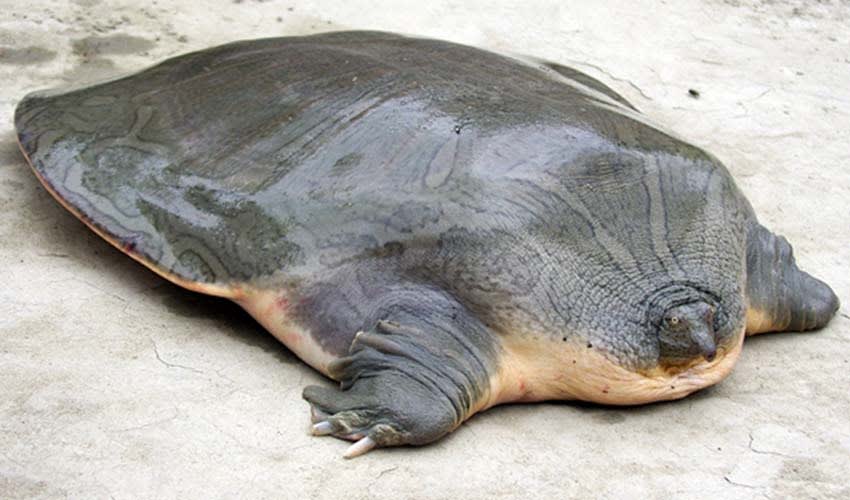
One of the most extraordinary and elusive freshwater turtles of South Asia — a flat, sand-colored phantom built for life in big, fast-moving rivers. Found primarily in the Ganges, Yamuna, Godavari, Mahanadi, and Brahmaputra river systems of India, Nepal, and Bangladesh, it belongs to the softshell turtle family but takes streamlining to an extreme. This species has a pancake-flat body, a flexible, leathery shell, and a narrow, tube-like snout that works like a snorkel. Combined with its sandy, mottled patterning, it vanishes effortlessly into the riverbed, leaving only two tiny nostrils peeking out of the substrate.
Instead of cruising around in search of prey, it buries itself in sand, keeping still as driftwood until a fish swims by. Then, in a lightning-fast strike powered by its long neck, it snaps up its meal. Fish make up the majority of its diet, but it will also take crustaceans, mollusks, and aquatic insects. The turtle’s flattened shape and smooth shell give it a hydrodynamic advantage, allowing it to ride river currents or slide beneath the sand with minimal effort. Even its skull is specialized — elongated and reinforced for suction-style feeding.
Breeding takes place during the dry season, when females come ashore on sandy riverbanks to dig deep nests and lay clutches of spherical eggs. Hatchlings emerge months later, instinctively heading for the water and burrowing into softer sediment for safety. This reliance on natural sandbanks and undisturbed river margins makes the species highly sensitive to human disturbance. The turtle requires clean, flowing rivers, deep channels, and stretches of natural sand — ingredients that are disappearing fast across its range.
Unfortunately, the Indian narrow-headed softshell turtle is now critically endangered. Major threats include sand mining, river damming, pollution, overfishing, and accidental capture in fishing nets. Historically, it was also hunted for meat and eggs, and illegal collection still occurs in some regions. Its shy nature and habit of staying buried mean populations can decline dramatically before researchers even notice.
Distribution
 Bangladesh
 India
India Myanmar
 Pakistan
Anything we've missed?
Help us improve this page by suggesting edits. Glory never dies!
Suggest an editGet to know me
Terrestrial / Aquatic
Altricial / Precocial
Polygamous / Monogamous
Dimorphic (size) / Monomorphic
Active: Diurnal / Nocturnal
Social behavior: Solitary / Pack / Herd
Diet: Carnivore / Herbivore / Omnivore / Piscivorous / Insectivore
Migratory: Yes / No
Domesticated: Yes / No
Dangerous: Yes / No




