


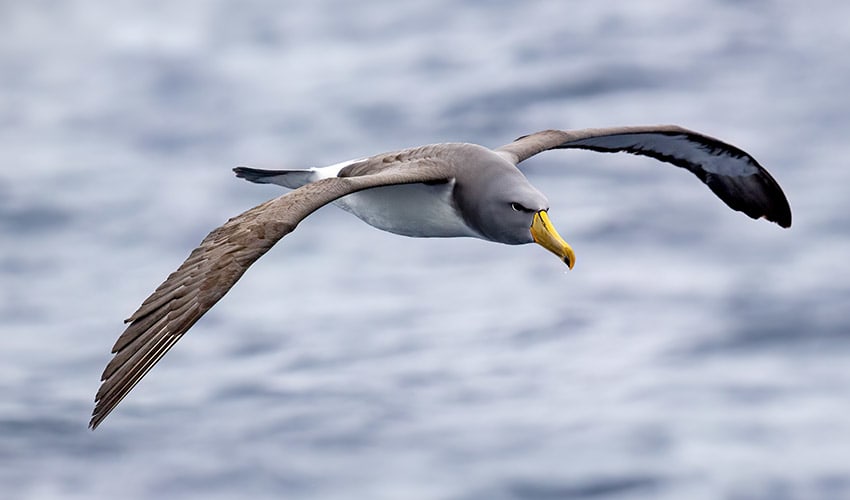
A bold, ocean-going bird that looks built for endless wind. It’s a large albatross with long, narrow wings for soaring, a hefty bill, and a confident, “no-nonsense” posture when it’s on land. In flight, it can seem almost effortless, gliding in wide arcs and using air currents like invisible highways. Up close, one of its most striking features is its bright yellow bill with a darker tip, which gives it a sharp, high-contrast look against its mostly pale head and body. Its back and upper wings are darker, creating a clean two-tone pattern that’s easy to recognize when it banks over the waves. Like many albatrosses, it is a master of energy-saving travel, able to cover huge distances with very little flapping—more like a living sailplane than a typical bird.
What really sets the Chatham albatross apart is how extraordinarily limited its breeding home is. It breeds almost entirely in one tiny place: The Pyramid, a steep rocky stack near the Chatham Islands east of New Zealand. Unlike many albatross species that have multiple breeding islands spread across a region, this bird’s “nursery” is basically a single, rugged landmark in the ocean. That makes it special—and also unusually vulnerable. It’s also distinct from close look-alikes in the wandering albatross “family” because of its overall shape and face pattern.
The Chatham albatross feeds mainly on squid and fish and will also grab other ocean food when opportunities appear. After breeding season, it ranges widely over the South Pacific and into productive feeding areas where currents concentrate prey. Yet when it’s time to raise a chick, it returns with surprising precision to the same small breeding zone.
Distribution
 American Samoa
 Antarctica
 Australia
 Chile
Chile Cook Islands
 French Polynesia
 New Caledonia
 New Zealand
 Niue
Niue Norfolk Island
 Peru
Peru Wallis & Futuna
Anything we've missed?
Help us improve this page by suggesting edits. Glory never dies!
Suggest an editGet to know me
Terrestrial / Aquatic
Altricial / Precocial
Polygamous / Monogamous
Dimorphic (size) / Monomorphic
Active: Diurnal / Nocturnal
Social behavior: Solitary / Pack / Colony
Diet: Carnivore / Herbivore / Omnivore / Piscivorous / Insectivore
Migratory: Yes / No
Domesticated: Yes / No
Dangerous: Yes / No




