


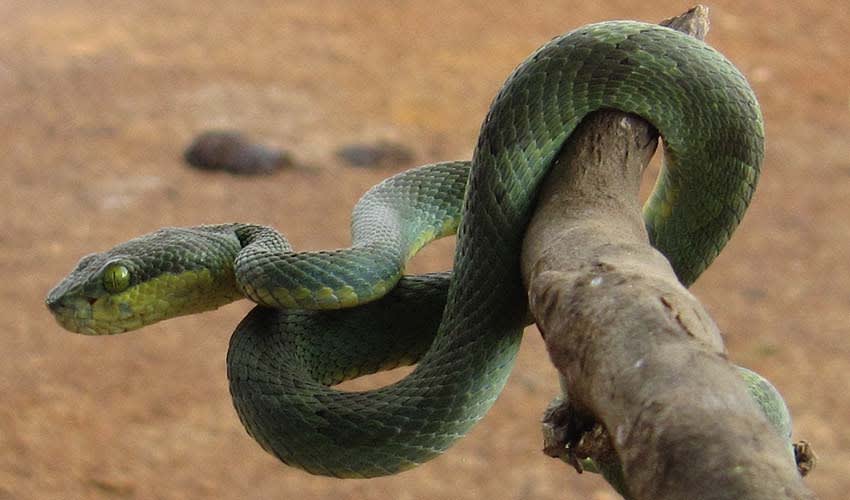
One of the most stunning and elusive pit vipers of Asia—a living emerald hidden among the forest leaves. Found mainly in southern and northeastern India, this slender, tree-dwelling snake gets its name from its habit of resting in bamboo groves and dense greenery, where its brilliant green scales blend seamlessly with the foliage. Despite its venomous bite, it’s a quiet and non-aggressive species, relying on stealth and camouflage rather than confrontation.
This viper is medium-sized, and its body is sleek and muscular, covered in shiny, keeled scales that shimmer in shades of leaf-green, yellow-green, or olive, with occasional gray or purplish hues. A pale line or streak—often white or yellow—runs along its sides, helping it blend into the light-dappled forest canopy. The tail tip is often red or yellow, possibly serving as a lure to attract curious frogs and lizards. Like all pit vipers, it has heat-sensing pits between the eyes and nostrils that allow it to detect warm-blooded prey even in darkness.
The common bamboo viper is an arboreal ambush predator, preferring to perch on branches or low shrubs near forest streams and clearings. At night, it comes alive, waiting motionless for frogs, lizards, small mammals, or birds to wander within striking distance. Its venom is hemotoxic, affecting blood and tissue, and while a bite can cause severe pain and swelling, it is rarely fatal with proper treatment. By day, it rests quietly, often coiled on a branch or in thick foliage, its green body disappearing completely into the surrounding vegetation.
Distribution
 India
IndiaAnything we've missed?
Help us improve this page by suggesting edits. Glory never dies!
Suggest an editGet to know me
Terrestrial / Aquatic
Altricial / Precocial
Polygamous / Monogamous
Dimorphic (size) / Monomorphic
Active: Diurnal / Nocturnal
Social behavior: Solitary / Pack / Herd
Diet: Carnivore / Herbivore / Omnivore / Piscivorous / Insectivore
Migratory: Yes / No
Domesticated: Yes / No
Dangerous: Yes / No




