


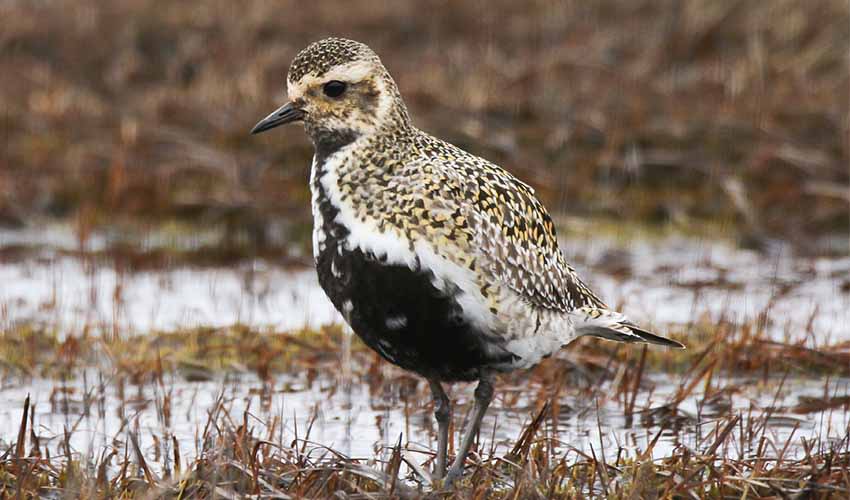
This bird really shows off the changing seasons in its feathers. In summer, you can spot them by their eye-catching tuxedo look: a jet-black face, throat, and belly set off by a golden, patterned brown back. What sets them apart from close relatives like the American or Pacific golden plovers is a clean white stripe running along their sides. This bright line separates the dark underside from the speckled gold top, making them look even more sharply dressed than other plovers.
But these birds are more than just good-looking—they are true endurance athletes. Unlike many birds that hop and flutter, the European golden plover is made for long-distance flights. They fly fast, at speeds that would get you a speeding ticket in a school zone. One thing that makes them relatable is their social nature; they don’t like being alone. You’ll often see them in huge flocks, sometimes with thousands of birds. They also get along well with other species, often seen in fields with Northern Lapwings. Their large groups help them stay safe, as all those extra eyes watch for predators while they search for food in the mud.
Another interesting thing about these birds is their place in history. The European golden plover is actually the reason the Guinness World Records book was created. In the 1950s, the managing director of Guinness Brewery argued with friends on a hunting trip about which game bird was the fastest in Europe—the golden plover or the red grouse. When he couldn’t find the answer in any book, he saw an opportunity to make a book that could settle these kinds of debates. So, if you’ve ever been amazed by a world record for the longest fingernails or the biggest pizza, you have this gold-speckled bird to thank for inspiring it.
Distribution
 Albania
 Armenia
 Austria
 Azerbaijan
 Belarus
 Belgium
 Bosnia And Herz.
 Bulgaria
 Croatia
 Cyprus
 Czechia
 Denmark
 Estonia
 Faroe Islands
 Finland
 France
 Germany
 Greece
 Greenland
 Hungary
 Iceland
 Ireland
 Italy
Italy Latvia
 Liechtenstein
 Lithuania
 Luxembourg
 Malta
Malta Montenegro
 Netherlands
 North Macedonia
 Norway
 Poland
 Portugal
 Romania
 Russia
 Serbia
 Slovakia
 Slovenia
 Spain
Svalbard
Spain
Svalbard Sweden
 Switzerland
 Turkey
 United Kingdom
Anything we've missed?
Help us improve this page by suggesting edits. Glory never dies!
Suggest an editGet to know me
Terrestrial / Aquatic
Altricial / Precocial
Polygamous / Monogamous
Dimorphic (size) / Monomorphic
Active: Diurnal / Nocturnal
Social behavior: Solitary / Pack / Flock
Diet: Carnivore / Herbivore / Omnivore / Piscivorous / Insectivore
Migratory: Yes / No
Domesticated: Yes / No
Dangerous: Yes / No




