


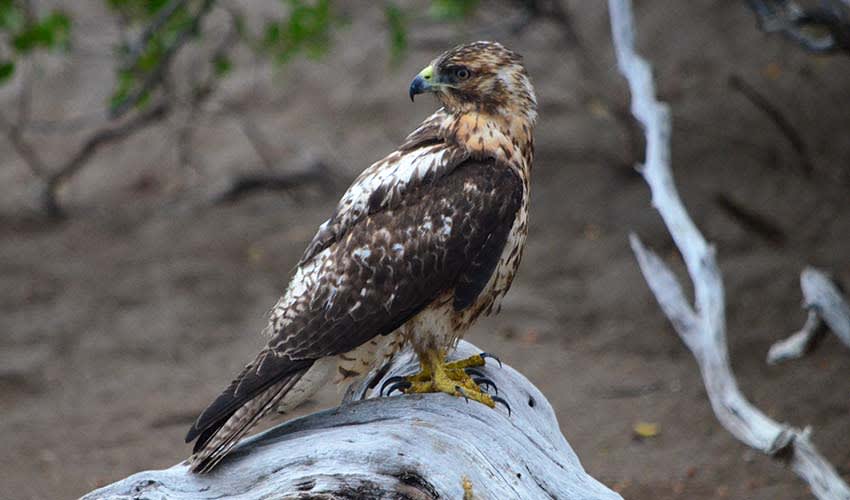
The top bird predator of the Galapagos Islands and one of the most iconic animals found in this unique ecosystem. It lives only on these islands, making it a true island native shaped by isolation and time. Medium to large in size, the Galapagos hawk has broad wings, a strong body, and a hooked beak designed for tearing food. Its feathers are mostly dark brown with lighter markings underneath, giving it a bold and powerful appearance when flying or perched on lava rocks. Because it has few natural enemies, the hawk often appears confident and calm, even around people.
One of the most striking features of the Galapagos hawk is its lack of fear toward humans. Unlike many hawks that keep their distance, this species may perch nearby and watch quietly, a result of evolving in an environment with little threat from people. This behavior makes it easier to observe than many birds of prey. The hawk is often seen soaring over open land, coastlines, and volcanic terrain, or standing upright on rocks and cactus tops while scanning for food. Its strong wings allow it to glide effortlessly on ocean breezes and rising warm air.
What truly sets the Galapagos hawk apart from other hawks is its unusual social and breeding behavior. In many areas, several males may mate with a single female, a rare system among birds of prey. All the males help defend the nest and bring food for the chicks. This cooperative behavior increases the chances of survival in an environment where food can be unpredictable. The nests are usually built in trees, shrubs, or on rocky ledges, and the young hawks grow up quickly, learning to hunt and fly in a challenging landscape.
Distribution
 Ecuador
 Official estimate
Anything we've missed?
Help us improve this page by suggesting edits. Glory never dies!
Suggest an editGet to know me
Terrestrial / Aquatic
Altricial / Precocial
Polygamous / Monogamous
Dimorphic (size) / Monomorphic
Active: Diurnal / Nocturnal
Social behavior: Solitary / Pack / Herd
Diet: Carnivore / Herbivore / Omnivore / Piscivorous / Insectivore
Migratory: Yes / No
Domesticated: Yes / No
Dangerous: Yes / No




