


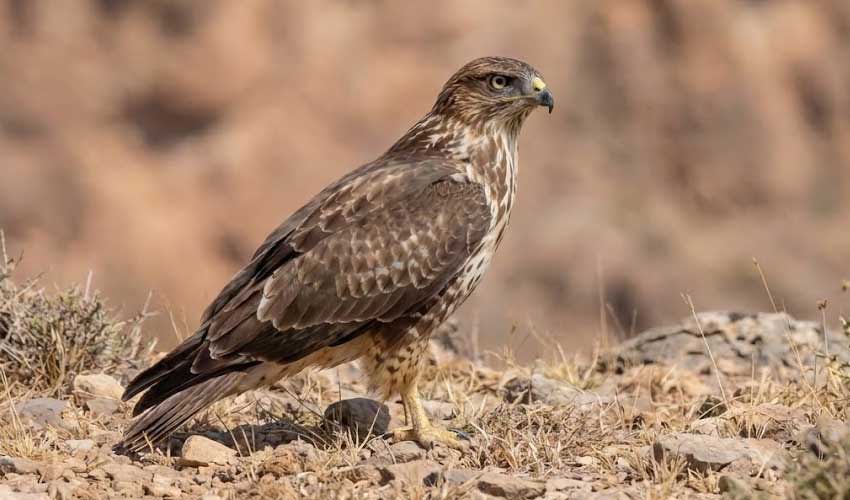
A rare and striking bird of prey found only on the island of Socotra, a remote archipelago in the Arabian Sea known for its unusual wildlife. As one of the island’s few large predators, the Socotra buzzard plays an important role in the local ecosystem. It is a medium-to-large buzzard with broad wings, a sturdy body, and a strong hooked beak. Its plumage is mostly brown, with lighter underparts and subtle markings that help it blend into rocky landscapes and dry woodland.
One of the most distinctive characteristics of the Socotra buzzard is its isolation. Unlike many buzzards that have wide ranges across continents, this species is found nowhere else in the world. Over time, it has adapted to Socotra’s dry climate, rugged terrain, and limited resources. It is often seen gliding above cliffs, hills, and open plains, using warm air currents to stay aloft with little effort. When perched, it favors high vantage points such as rocky outcrops or tall trees, where it can survey the land below for movement.
What truly sets the Socotra buzzard apart from other buzzards is its diet and hunting style. On an island with few mammals, it has learned to be flexible. It feeds on small animals such as reptiles, birds, and rodents, and it will also eat insects and carrion when available. This adaptability is key to its survival in an environment where food can be scarce. Rather than chasing prey over long distances, it often relies on patience, watching quietly before swooping down in a controlled descent. Its broad wings and steady flight make it well-suited for this calm but effective hunting method.
Distribution
 Yemen
Yemen Official estimate
Anything we've missed?
Help us improve this page by suggesting edits. Glory never dies!
Suggest an editGet to know me
Terrestrial / Aquatic
Altricial / Precocial
Polygamous / Monogamous
Dimorphic (size) / Monomorphic
Active: Diurnal / Nocturnal
Social behavior: Solitary / Pack / Herd
Diet: Carnivore / Herbivore / Omnivore / Piscivorous / Insectivore
Migratory: Yes / No
Domesticated: Yes / No
Dangerous: Yes / No




