


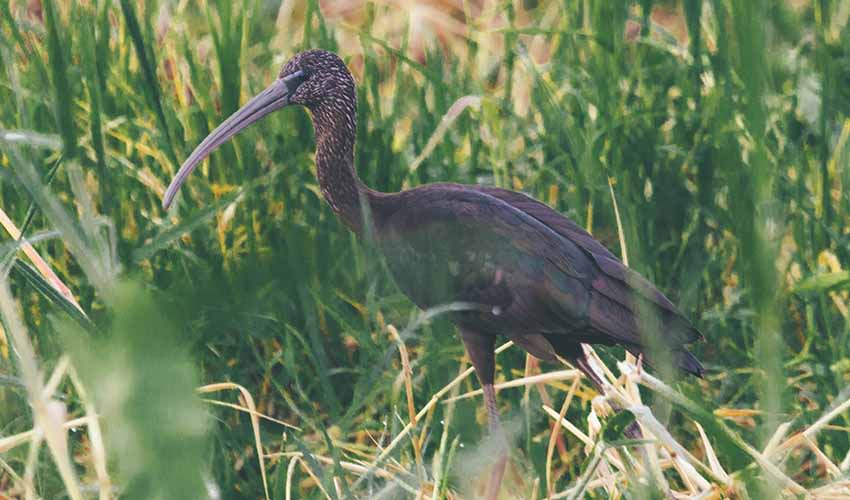
True to its name, the largest ibis in the world, it is a towering and majestic bird that once roamed widely across mainland Southeast Asia. Today, it survives mostly in the remote forests and wetlands of Cambodia, with tiny remnant populations in Laos and possibly Vietnam. It cuts an impressive figure: slate-gray plumage, a long, heavy down-curved bill, and striking orange-red skin around the eyes. Its deep, resonant calls — sometimes described as prehistoric-sounding “wok-wok-wok” grunts — add to its powerful presence in the forests it calls home.
The giant ibis thrives in lowland dry deciduous forests, especially areas dotted with seasonal pools, swamps, and river edges. Unlike many wetland ibises, it does not rely on vast marshes; instead, it depends on ephemeral waterholes, mudflats, and shallow forest pools where it probes for frogs, eels, large insects, snails, and even small snakes. These seasonal wetlands become lifelines during the dry season, concentrating prey and providing feeding grounds for both adults and juveniles. The species is mostly solitary or found in pairs, and it tends to be very shy, retreating quickly at the slightest disturbance.
Breeding takes place in the wet season, with pairs nesting high in tall trees — often Dipterocarp trees — that offer safety from ground predators. The nest itself is a large platform of sticks, sometimes reused for several seasons. The giant ibis typically lays only two eggs, and raising chicks requires stable conditions and an undisturbed habitat. As such, nesting success is tightly linked to the health of the surrounding forest. Juveniles are pale and scruffy compared to adults, with lighter bills and duller plumage, and they stay with parents for months as they learn to forage.
Distribution
 Cambodia
 Laos
Laos Thailand
 Official estimate
 Vietnam
Anything we've missed?
Help us improve this page by suggesting edits. Glory never dies!
Suggest an editGet to know me
Terrestrial / Aquatic
Altricial / Precocial
Polygamous / Monogamous
Dimorphic (size) / Monomorphic
Active: Diurnal / Nocturnal
Social behavior: Solitary / Pack / Herd
Diet: Carnivore / Herbivore / Omnivore / Piscivorous / Insectivore
Migratory: Yes / No
Domesticated: Yes / No
Dangerous: Yes / No




