


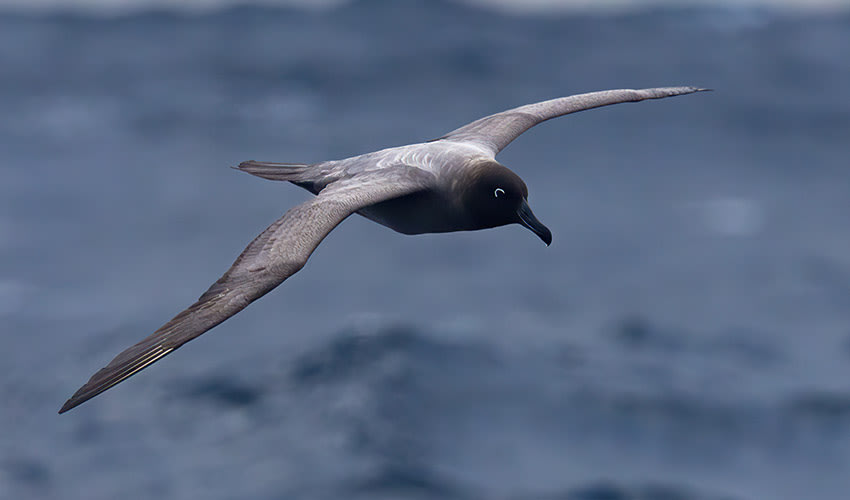
One of the most elegant and striking seabirds of the Southern Ocean, admired for its smooth flight and subtle, beautiful coloring. It gets its name from the soft gray “mantle” that covers its back and wings, which contrasts gently with its pale face and underparts. This refined appearance makes it stand out even among other albatross species. With long, narrow wings built for gliding, the light-mantled albatross can soar effortlessly above the waves for hours at a time. Instead of constant flapping, it uses strong ocean winds to travel vast distances while saving energy.
One feature that distinguishes the light-mantled albatross from many other albatrosses is its preference for colder, more southern waters. It often lives closer to Antarctica than most of its relatives, thriving in some of the harshest ocean environments on Earth. Despite these conditions, it is perfectly adapted to life at sea. Its strong wings allow it to handle powerful winds and rough weather with ease. The bird’s calm, steady flight reflects its confidence in these extreme surroundings. Unlike some larger albatross species, the light-mantled albatross has a slimmer build, which contributes to its swift, agile flight.
The light-mantled albatross spends most of its life far from land, roaming the Southern Ocean in search of food. Its diet mainly includes squid and small fish, which it captures from the surface of the water. It has excellent vision and a strong sense of smell, helping it locate food across vast, empty stretches of ocean. Young birds may spend several years at sea before returning to land for the first time. During this time, they learn how to navigate winds and waves, slowly mastering the skills needed for survival.
Distribution
 Antarctica
 Argentina
 Australia
 Bouvet Island
 Brazil
 Chile
Chile Falkland Islands
 French Polynesia
 French Southern T.
Heard & McDonald
French Southern T.
Heard & McDonald Mauritius
 New Zealand
 South Africa
 South Georgia
Anything we've missed?
Help us improve this page by suggesting edits. Glory never dies!
Suggest an editGet to know me
Terrestrial / Aquatic
Altricial / Precocial
Polygamous / Monogamous
Dimorphic (size) / Monomorphic
Active: Diurnal / Nocturnal
Social behavior: Solitary / Pack / Flock
Diet: Carnivore / Herbivore / Omnivore / Piscivorous / Insectivore
Migratory: Yes / No
Domesticated: Yes / No
Dangerous: Yes / No




