


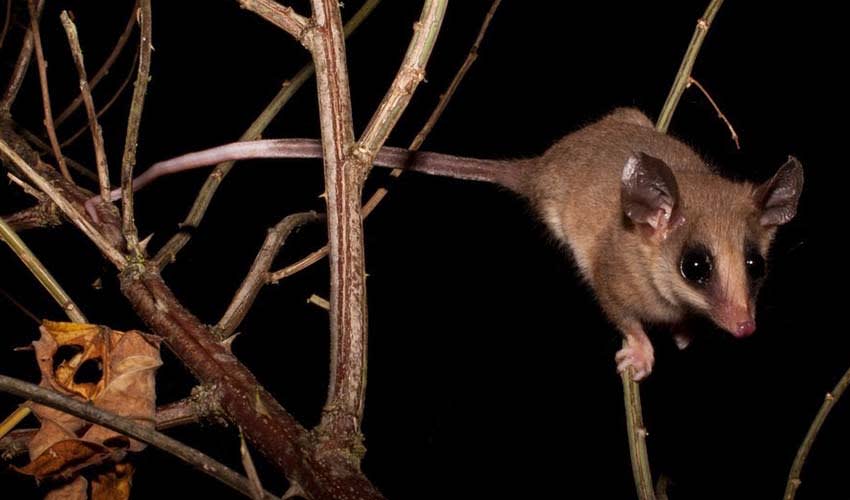
A tiny, night-active marsupial that lives like a quiet acrobat in the forests along the western slopes of the Andes. It’s small and light, with a pointed snout, big dark eyes made for low light, and a long, flexible tail that acts like a balancing rope when it moves through branches. The “woolly” part of its name comes from its thicker, softer-looking coat compared with many other mouse opossums—more plush jacket than sleek fur—helpful for cool, damp nights in forest shade. Its coloring is often warm brown on the back and sides with a paler underside and buffy cheeks, and it tends to have fairly subtle eye markings rather than bold, dramatic “mask” lines.
Many of its close relatives are spread across broad areas of northern and central South America, but the little woolly mouse opossum is more of a local specialist, known mainly from the western Andean side in Colombia, Ecuador, and Peru, from near sea level up to about 1,500 meters. That range also shapes its lifestyle: it can be found in lowland rainforest and in cooler, misty cloud forest, which means it’s living in places where the weather can change quickly, and the forest stays wet and layered. It’s also typically described as mostly solitary—more “quiet solo forager” than “group traveler”—which fits an animal that survives by being hard to notice.
After sunset, this opossum becomes a careful forager and hunter. It moves in a stop-and-listen rhythm: a few steps, a sniff, a pause, then another gentle climb, as if it’s reading the forest like a map. It eats a flexible mix of foods, often including insects and other small prey, plus fruit when it finds it—basically taking whatever the night offers. That variety is a smart strategy in mountain forests where the menu can change with season, rain, and which trees are fruiting.
Distribution
 Brazil
 Colombia
 Ecuador
 Peru
Peru Venezuela
Anything we've missed?
Help us improve this page by suggesting edits. Glory never dies!
Suggest an editGet to know me
Terrestrial / Aquatic
Altricial / Precocial
Polygamous / Monogamous
Dimorphic (size) / Monomorphic
Active: Diurnal / Nocturnal
Social behavior: Solitary / Pack / Herd
Diet: Carnivore / Herbivore / Omnivore / Piscivorous / Insectivore
Migratory: Yes / No
Domesticated: Yes / No
Dangerous: Yes / No




