


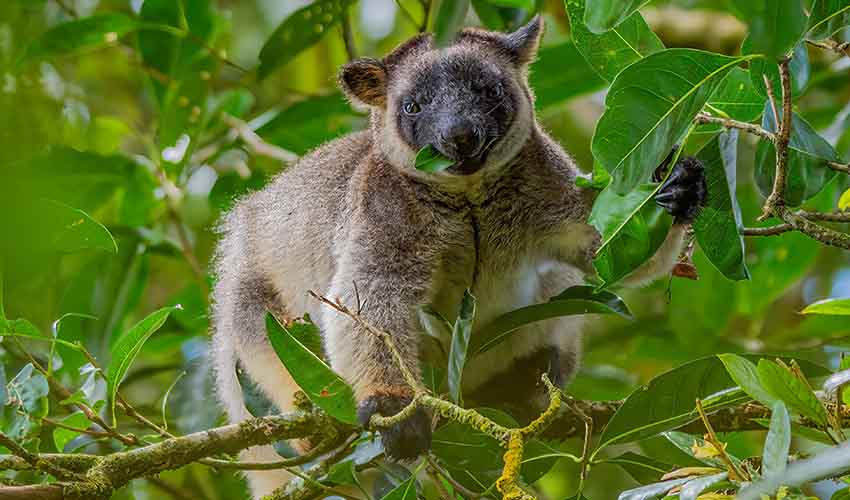
Found in the rainforests of northeastern Australia, it has a compact, muscular body built for climbing rather than sprinting. Its arms and legs are powerful and flexible, and its paws have strong claws that help it grip bark like a climber hugging a rock wall. Compared with the classic outback kangaroo, it looks almost “bearish” in posture—more about pulling, balancing, and hugging branches than bounding across open ground.
Many tree-kangaroo species live on the island of New Guinea and can have brighter, more patterned coats, but Lumholtz’s tends to look more understated—made to blend into dense foliage and tree trunks rather than show off. It’s also generally smaller and more compact than some of its relatives, which helps it navigate tight tangles of vines and the busy architecture of rainforest trees. While different species share the same basic tree-kangaroo blueprint—strong limbs, balancing tail, and a talent for life above the ground—Lumholtz’s is especially associated with cool, misty upland forests and the kind of thick cover where an animal can be only a few meters away and still vanish into shadow.
Lumholtz’s tree-kangaroo spends much of its time alone, resting in the canopy and feeding on a mix of leaves, fruit, and other plant parts it can reach without wasting energy. It doesn’t need to chase food; it needs to choose the right tree, and it treats the rainforest like a living menu. You might imagine it hopping wildly from branch to branch, but the reality is more like a careful gymnast: controlled movements, steady grips, and smart balance. When it does need to travel, it can climb with impressive strength and can come down to the ground to move between trees—though it looks far less graceful there, because its body is optimized for climbing rather than long-distance ground travel.
Distribution
 Australia
Anything we've missed?
Help us improve this page by suggesting edits. Glory never dies!
Suggest an editGet to know me
Terrestrial / Aquatic
Altricial / Precocial
Polygamous / Monogamous
Dimorphic (size) / Monomorphic
Active: Diurnal / Nocturnal
Social behavior: Solitary / Pack / Herd
Diet: Carnivore / Herbivore / Omnivore / Piscivorous / Insectivore
Migratory: Yes / No
Domesticated: Yes / No
Dangerous: Yes / No




