


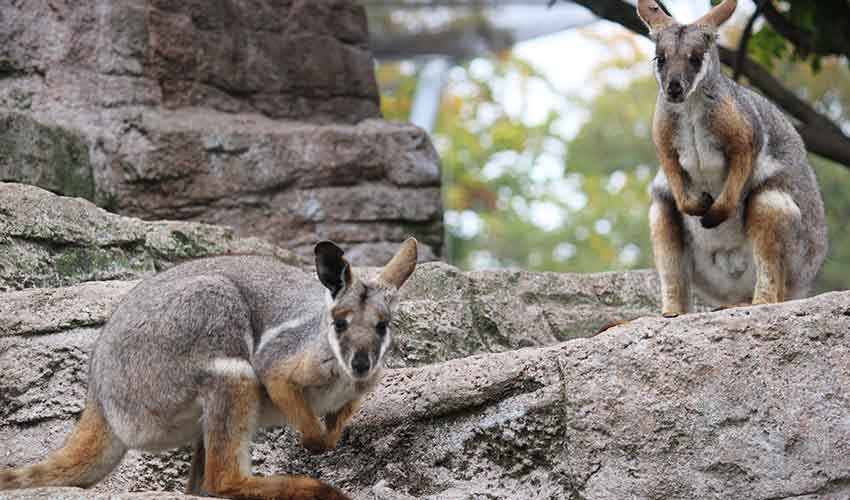
One of Australia’s most striking wallabies—so colorful and patterned that it can look almost “painted” when sunlight hits it on a cliff face. It lives in rugged, rocky country in the drier parts of south-central Australia, especially around steep hills, gorges, and broken escarpments where boulders stack like natural staircases. Its body is made for that terrain: powerful back legs for spring-loaded leaps, a long tail for balance, and forepaws that help it grip and brace on uneven surfaces. The feature that gives it its name—those yellowish feet and lower legs—stands out against a coat marked with bands and stripes that help break up its outline among rocks and shadow.
What really distinguishes this rock-wallaby is its “designer outfit.” Along its back and shoulders, it often shows a mix of gray, brown, and rusty tones, with pale stripes and darker bands that can resemble ripples of color. Its face is especially memorable: it commonly has bold markings, including a pale cheek stripe and darker lines that make it look alert and sharply defined, even at a distance. This isn’t just for show. In a landscape of sunlit stone, deep crevices, and patchy shade, strong patterns can make an animal harder to track with the eye—your brain sees “rock textures” instead of “wallaby shape.”
Its daily life is all about using rocks as both home and shield. During the hottest parts of the day, it rests in cool caves, shaded cracks, and overhangs where the temperature can be noticeably lower than the open ground. When it comes out to feed—often in the late afternoon, evening, and early night—it may travel from its rocky refuge to nearby shrubs, grasses, and other plants, usually staying close to the safety of boulders.
Distribution
 Australia
 Official estimate
Anything we've missed?
Help us improve this page by suggesting edits. Glory never dies!
Suggest an editGet to know me
Terrestrial / Aquatic
Altricial / Precocial
Polygamous / Monogamous
Dimorphic (size) / Monomorphic
Active: Diurnal / Nocturnal
Social behavior: Solitary / Pack / Herd
Diet: Carnivore / Herbivore / Omnivore / Piscivorous / Insectivore
Migratory: Yes / No
Domesticated: Yes / No
Dangerous: Yes / No




