


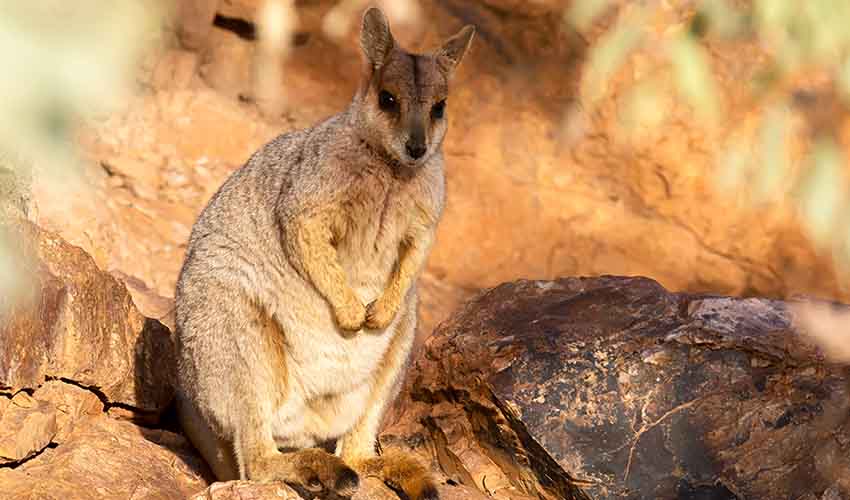
One of Australia’s most eye-catching rock-wallabies, famous for a subtle but unmistakable splash of color: a gray-to-purple wash across the neck and upper shoulders that can look like someone lightly brushed it with violet dust. It lives in rugged, rocky country in northern Australia, where cliffs, boulder piles, and steep escarpments create a natural obstacle course. Like all rock-wallabies, it’s built for that terrain—strong hind legs for spring-loaded jumps, forepaws that can brace on uneven stone, and a long tail that works like a balancing pole when it lands on slanted ledges.
What distinguishes the purple-necked rock-wallaby from other rock-wallabies is that signature neck coloring paired with a generally warm, earthy coat that blends into rock and dry vegetation. Many rock-wallabies look similar at a distance—gray-brown bodies, pale bellies, and subtle stripes—so a consistent color patch on the neck is a handy clue. The purple tone isn’t usually a bright, cartoon purple; it’s more like a smoky mauve or dusky violet, and it can vary with lighting and the individual.
Its daily life follows the classic rock-wallaby rhythm: hide smart, feed carefully, and let the landscape do the heavy lifting. During the day, it often shelters in cool crevices, caves, and shaded overhangs where temperatures stay lower than the exposed rock outside—natural air-conditioning in a harsh climate. When late afternoon or evening arrives, it comes out to browse on grasses, herbs, and leaves from shrubs, usually keeping close to the rocky refuge. That way, if danger appears, it doesn’t need to outrun anything across open ground; it just needs one clean hop back into the boulder maze. Once among rocks, it can zigzag and climb with impressive accuracy, landing, pivoting, and stopping on slopes that look impossible to navigate.
Distribution
 Australia
 Official estimate
Anything we've missed?
Help us improve this page by suggesting edits. Glory never dies!
Suggest an editGet to know me
Terrestrial / Aquatic
Altricial / Precocial
Polygamous / Monogamous
Dimorphic (size) / Monomorphic
Active: Diurnal / Nocturnal
Social behavior: Solitary / Pack / Herd
Diet: Carnivore / Herbivore / Omnivore / Piscivorous / Insectivore
Migratory: Yes / No
Domesticated: Yes / No
Dangerous: Yes / No




