


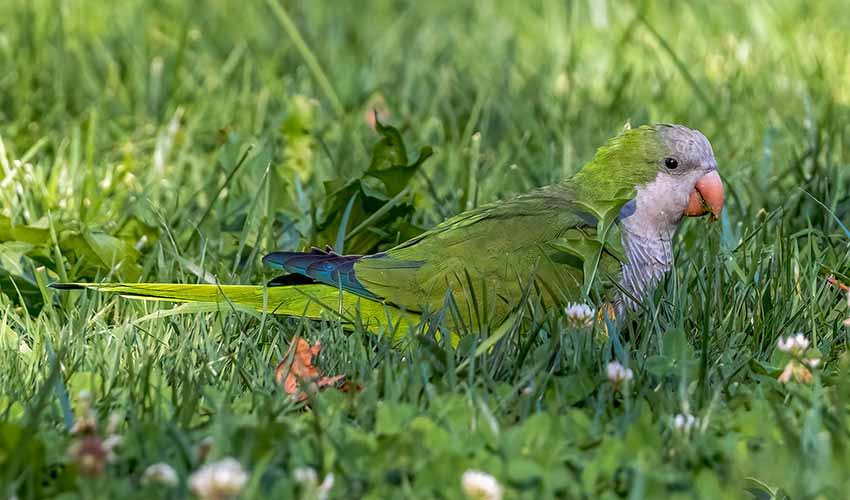
A bright, noisy, and highly social bird from South America. It is usually green on the back and wings, with a pale gray face, throat, and chest, which makes it easy to recognize. Its long, pointed tail, strong, curved beak, and quick movements give it the lively look common to many parrots. What makes the monk parakeet especially interesting is that it does not behave like the “typical” parrot in one big way: instead of nesting in tree holes, it builds large nests made of sticks. This sets it apart from most parrots, which usually depend on hollow trees, cliffs, or other ready-made spaces for raising their young.
One of the coolest things about the monk parakeet is that its nest can become a giant bird apartment. A single pair may start the nest, but several pairs can add to it until the whole structure becomes huge. Each pair may have its own chamber inside, almost like separate rooms in a shared house. These nests are often built high in trees, but monk parakeets are also famous for building them on power poles, towers, and other human-made structures. This habit has helped them survive in cities, farms, and parks far from their original home. In some places, their nests can become so large and heavy that people have to remove them for safety.
Monk parakeets are also different because they are very adaptable. They can live in warm grasslands, farmland, wooded areas, and busy cities. They eat many kinds of food, including seeds, fruits, flowers, buds, grains, and sometimes crops. Their flexible diet helps them thrive where other birds might struggle. They are also smart and curious, using their strong beaks not only to eat but also to chew, explore, and build. Their loud calls may sound harsh to some people, but they are important for keeping the flock together.
Distribution
 Argentina
 Austria
 Bahamas
 Official estimate
 Belgium
 Bermuda
 Bolivia
 Brazil
 Canada
 Cayman Islands
 Chile
Chile Czechia
 France
 Germany
 Israel
Guadeloupe
Israel
Guadeloupe Japan
Japan Mexico
 Paraguay
 Puerto Rico
 Slovakia
 Spain
Spain US Virgin Islands
 United States
 Uruguay
Anything we've missed?
Help us improve this page by suggesting edits. Glory never dies!
Suggest an editGet to know me
Terrestrial / Aquatic
Altricial / Precocial
Polygamous / Monogamous
Dimorphic (size) / Monomorphic
Active: Diurnal / Nocturnal
Social behavior: Solitary / Pack / Flock
Diet: Carnivore / Herbivore / Omnivore / Piscivorous / Insectivore
Migratory: Yes / No
Domesticated: Yes / No
Dangerous: Yes / No




