


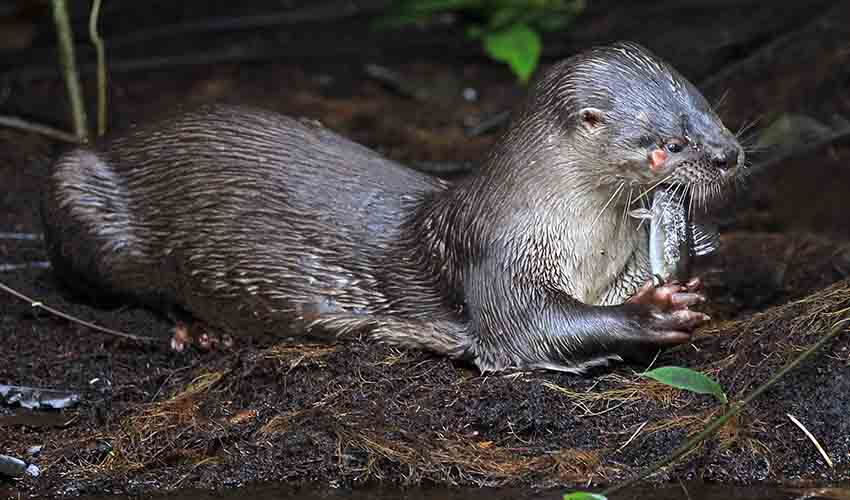
The Americas’ wide-ranging “river acrobat,” living from parts of Mexico and Central America down through much of South America. It has the classic otter build: a long, streamlined body, short, powerful legs, webbed feet, and a thick tail that works like a steering paddle. Its fur is usually dark brown to gray-brown, often with a paler throat and chest that can look like a softly painted bib. That lighter patch varies a lot from otter to otter, almost like a natural fingerprint. Up close, its face is all whiskers and curiosity—those whiskers help it detect tiny water movements, making it easier to find prey even when the water is cloudy or the light is low.
What makes the Neotropical otter stand out among otters is its adaptability. It can live in fast rivers, slow streams, forest creeks, lakes, wetlands, and even coastal areas like mangroves and estuaries, as long as there’s enough food and enough cover to hide. It’s also different from the famous giant river otter in both size and lifestyle: the Neotropical otter is smaller, usually more solitary, and far more likely to keep a low profile. Where giant river otters can be loud, social, and group-living, Neotropical otters often behave like quiet, private neighbors—hard to spot, quick to vanish, and most active when people aren’t around. Compared with sea otters, which spend much of their time floating and feeding offshore, the Neotropical otter is a shoreline and freshwater specialist, built for weaving between banks, roots, and rocks.
In daily life, it’s a persistent hunter with a flexible menu. Fish are a major food source, but it also catches crabs and other water creatures, and it will take whatever is easiest and most available. It’s an efficient swimmer, using smooth body waves and strong kicks to surge forward, then braking and turning with its tail and webbed feet like a kayak with a built-in motor.
Distribution
 Argentina
 Belize
 Bolivia
 Brazil
 Colombia
 Costa Rica
 Ecuador
 El Salvador
 French Guiana
 Guatemala
 Guyana
 Honduras
 Mexico
 Nicaragua
 Panama
 Paraguay
 Peru
Peru Suriname
 Uruguay
 Venezuela
Anything we've missed?
Help us improve this page by suggesting edits. Glory never dies!
Suggest an editGet to know me
Terrestrial / Aquatic
Altricial / Precocial
Polygamous / Monogamous
Dimorphic (size) / Monomorphic
Active: Diurnal / Nocturnal
Social behavior: Solitary / Pack / Herd
Diet: Carnivore / Herbivore / Omnivore / Piscivorous / Insectivore
Migratory: Yes / No
Domesticated: Yes / No
Dangerous: Yes / No




