


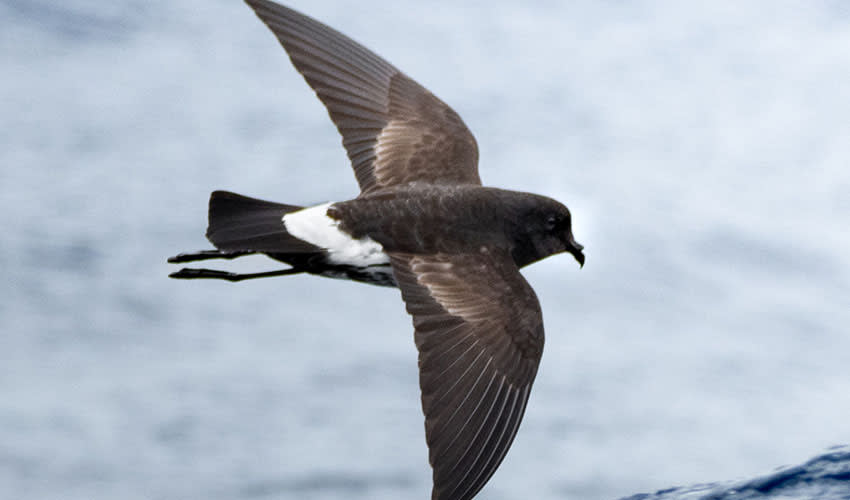
One of the most astonishing comeback stories in modern ornithology — a bird that returned from the dead. Once believed extinct for more than a century, this small, dark seabird was spectacularly rediscovered in 2003 near Little Barrier Island (Hauturu-o-Toi) off New Zealand’s North Island. Before that, it was known only from a handful of 19th-century museum specimens. The rediscovery stunned scientists and birders worldwide, proving that even in a well-studied country like New Zealand, nature can still deliver miracles.
Slightly larger than a sparrow, the New Zealand storm-petrel is delicate yet perfectly adapted to a life at sea. It has sooty-black plumage, a bright white belly streaked with dark lines, and a distinctive white rump patch — all features that flash dramatically as it flutters and glides above the waves. Like other storm-petrels, it has a unique “pattering” feeding behavior: it hovers close to the surface, rapidly beating its wings while touching the water lightly with its feet as it picks tiny prey from the surface. Its diet consists mainly of plankton, small crustaceans, and fish larvae, which it finds in nutrient-rich ocean currents. Watching one feed is like seeing a living wisp of smoke dance over the sea.
The species nests on steep, forested islands free from invasive predators, laying a single white egg in a burrow or rock crevice. It breeds during the Southern Hemisphere summer and spends the rest of the year roaming the open ocean, likely around the northern waters of New Zealand and possibly farther into the tropical Pacific. The rediscovery prompted intensive conservation research, and after years of searching, scientists confirmed a breeding colony on Te Hauturu-o-Toi/Little Barrier Island in 2013. This revelation was a turning point — not only confirming that the species had survived, but that it was reproducing successfully in the wild.
Distribution
 Australia
 New Zealand
Anything we've missed?
Help us improve this page by suggesting edits. Glory never dies!
Suggest an editGet to know me
Terrestrial / Aquatic
Altricial / Precocial
Polygamous / Monogamous
Dimorphic (size) / Monomorphic
Active: Diurnal / Nocturnal
Social behavior: Solitary / Pack / Flock
Diet: Carnivore / Herbivore / Omnivore / Piscivorous / Insectivore
Migratory: Yes / No
Domesticated: Yes / No
Dangerous: Yes / No




