


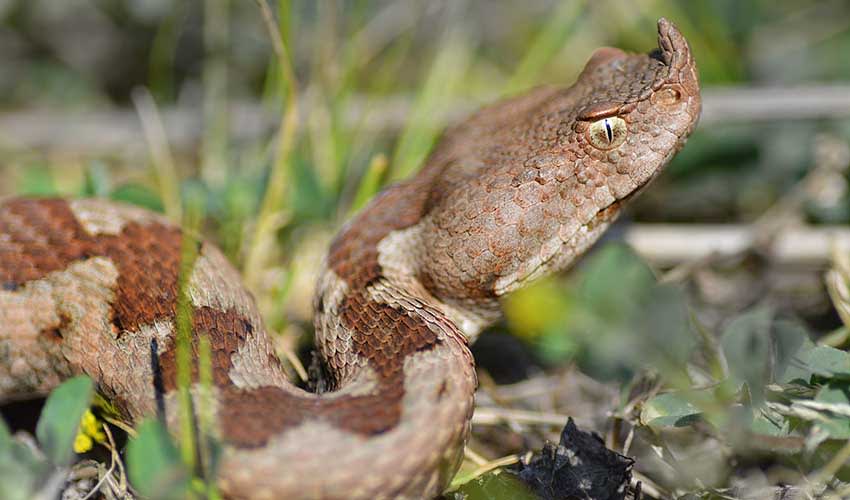
One of Europe’s most striking and recognizable snakes, famous for the distinctive horn-like scale that rises from the tip of its snout. Found across southern and southeastern Europe—including the Balkans, northern Italy, Austria, and parts of Turkey—this snake is both beautiful and formidable. Its coloration varies widely, from sandy beige to reddish-brown or gray, often adorned with a bold zigzag pattern running along its back. This intricate camouflage allows it to blend perfectly into the rocky slopes, dry scrublands, and vineyard terraces it calls home. Despite its fearsome appearance, the nose-horned viper is a cautious and secretive animal that avoids conflict whenever possible.
This viper’s “nose horn” isn’t a weapon, but rather a flexible structure made of modified scales. It may help break up the snake’s outline or provide sensory benefits in navigating its rugged environment. The species is typically found in dry, rocky terrain, often basking on stones or hiding beneath vegetation, rubble, or old walls. It’s most active during the day in cooler months and at dusk or night during the hot summer.
Like most vipers, it’s an ambush predator—it waits patiently for small mammals, birds, or lizards to come close, then strikes with lightning speed. Its venom is highly potent, combining hemotoxic and neurotoxic effects that quickly immobilize prey. Though its bite can be dangerous to humans, encounters are rare, and the snake usually relies on camouflage and retreats to avoid confrontation.
Distribution
 Albania
 Austria
 Bosnia And Herz.
 Bulgaria
 Croatia
 Georgia
 Greece
 Hungary
 Italy
Italy Montenegro
 North Macedonia
 Romania
 Serbia
 Slovenia
 Switzerland
 Turkey
Anything we've missed?
Help us improve this page by suggesting edits. Glory never dies!
Suggest an editGet to know me
Terrestrial / Aquatic
Altricial / Precocial
Polygamous / Monogamous
Dimorphic (size) / Monomorphic
Active: Diurnal / Nocturnal
Social behavior: Solitary / Pack / Herd
Diet: Carnivore / Herbivore / Omnivore / Piscivorous / Insectivore
Migratory: Yes / No
Domesticated: Yes / No
Dangerous: Yes / No




