


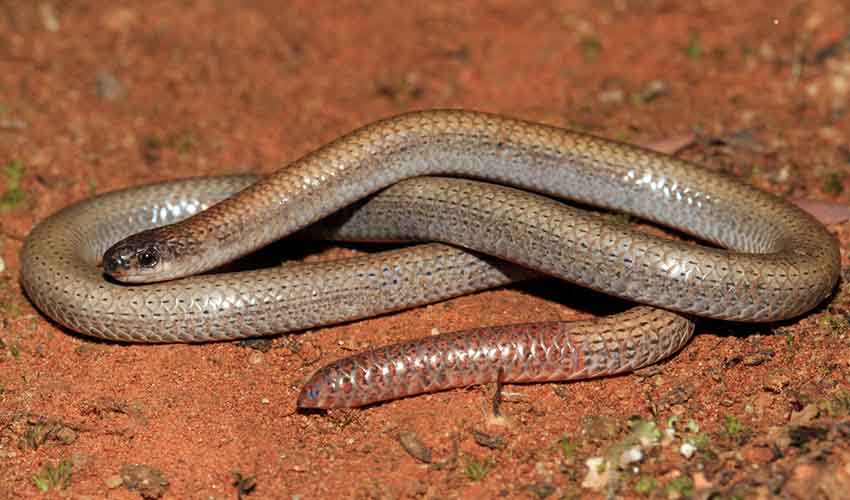
A tiny Australian reptile that looks like a cross between a baby snake and a glossy earthworm. Adults have a very slender body, a small, blunt head, and a short, round-tipped tail that’s often rosy or pinkish—hence the name. The head and neck are brown, the upper body is pale grey, and each scale on the back has a little dark bar, so from above it looks like a neat line of speckles running down the spine. The underside is white. At first glance, most people would call it a “little snake,” but it’s actually a legless lizard: it has tiny flap-like remnants of hind limbs near the tail, a flat, non-forked tongue, and lizard-style head scales.
Pink-tailed worm-lizards are strongly associated with natural temperate grasslands and open grassy woodlands that have scattered, lightly embedded surface rocks—often small pieces of granite or other stones partly sunk into the soil. They tuck themselves under rocks roughly the size of a dinner plate or smaller, sharing space with ant colonies. Instead of chasing moving insects, they behave more like careful raiders: they slip into ant burrows and feast mainly on ant eggs and larvae, especially those of certain small ant species. That diet makes them very dependent on both the right kind of rocks and the right kind of ants.
Their lifestyle is as secretive as their appearance suggests. Pink-tailed worm-lizards spend most of their time hidden under stones or in ant tunnels, in well-drained, sunny slopes along rivers and hills in parts of the ACT, New South Wales, and Victoria. You usually only see one when someone turns over exactly the right rock. They move with smooth, side-to-side waves of the body, slipping through soil and narrow spaces.
Distribution
 Australia
Anything we've missed?
Help us improve this page by suggesting edits. Glory never dies!
Suggest an editGet to know me
Terrestrial / Aquatic
Altricial / Precocial
Polygamous / Monogamous
Dimorphic (size) / Monomorphic
Active: Diurnal / Nocturnal
Social behavior: Solitary / Pack / Herd
Diet: Carnivore / Herbivore / Omnivore / Piscivorous / Insectivore
Migratory: Yes / No
Domesticated: Yes / No
Dangerous: Yes / No




