


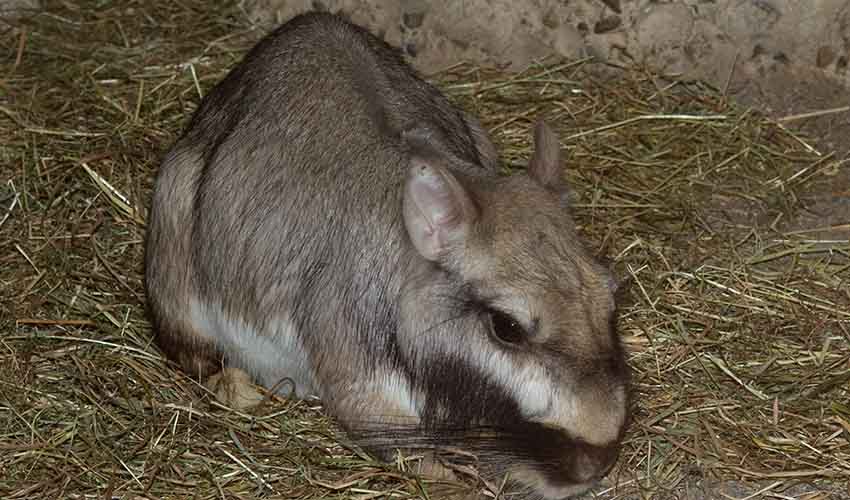
A large, burrowing creature known for its expressive face, social lifestyle, and complex underground colonies. Native to the grasslands, shrublands, and dry plains of Argentina, Paraguay, and parts of Bolivia, this species is the sole surviving member of its genus, Lagostomus, within the chinchilla family (Chinchillidae). Unlike its soft-furred, highland cousins, the plains viscacha has adapted to the harsh, open environments of the pampas, where survival depends on teamwork, endurance, and remarkable engineering skills.
Physically, the plains viscacha has a thick, soft fur that is typically grayish-brown on the back and white or cream-colored underneath, perfectly blending into the dusty landscapes it inhabits. The viscacha’s large black eyes, long whiskers, and rounded ears give it an alert and endearing expression, while its strong hind legs and powerful incisors are adapted for both hopping across the plains and gnawing through tough vegetation. Males are notably larger than females, with broader heads and stronger jaws—features that play a role in both digging and dominance displays within colonies.
Behaviorally, the plains viscacha is a highly social and vocal species, living in large colonies called vizcacheras. These are elaborate burrow systems that can house dozens of individuals and extend several meters underground, with multiple entrances and chambers. Each colony consists of several family groups, usually led by a dominant male, and features a dynamic social hierarchy. The viscachas work together to dig, maintain, and expand their burrows, creating long-lasting structures that are used for generations.
Their burrowing activities not only protect them from predators and extreme weather but also have important ecological effects, aerating the soil and providing shelter for other animals like reptiles, insects, and small birds. Around the burrow entrances, the animals clear away vegetation and often pile up debris such as stones, sticks, bones, and even human-made objects—possibly to mark territory or reinforce the structure.
Distribution
 Argentina
 Bolivia
 Paraguay
Anything we've missed?
Help us improve this page by suggesting edits. Glory never dies!
Suggest an editGet to know me
Terrestrial / Aquatic
Altricial / Precocial
Polygamous / Monogamous
Dimorphic (size) / Monomorphic
Active: Diurnal / Nocturnal
Social behavior: Solitary / Pack / Colony
Diet: Carnivore / Herbivore / Omnivore / Piscivorous / Insectivore
Migratory: Yes / No
Domesticated: Yes / No
Dangerous: Yes / No




