


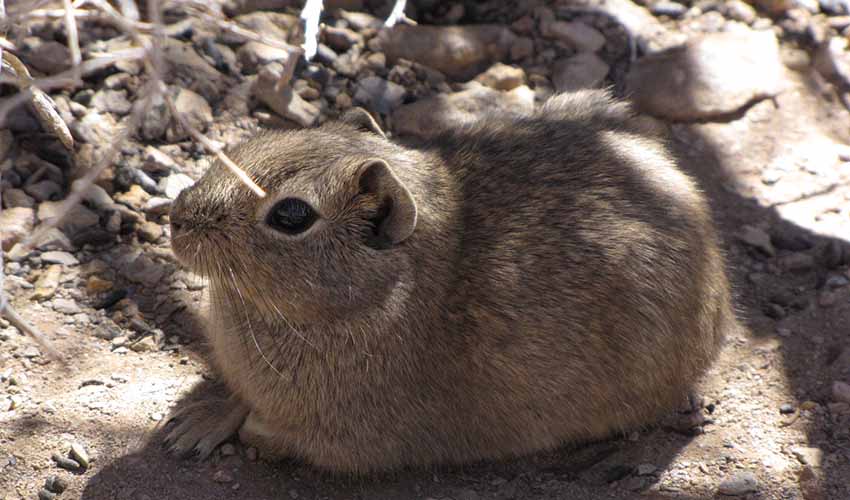
As the most widespread and best-known member of the mountain cavies (Microcavia), this species is a perfect example of quiet resilience—a creature that thrives in environments that would challenge most mammals. With its compact body, social habits, and ability to endure extreme heat and dryness, the southern mountain cavy has earned its place as one of the most resourceful small mammals of the Patagonian and Andean foothills.
Unlike its close relative, the guinea pig, it has shorter ears and limbs, a more streamlined body, and a short, barely visible tail. Its large dark eyes and twitching nose give it an alert and curious look—an important advantage in open terrain where predators can approach from any direction. Adapted for life among rocks and shrubs, its strong claws allow it to dig shallow burrows or navigate rugged ground, while its compact frame helps it squeeze into crevices for safety.
The southern mountain cavy is primarily herbivorous, feeding on grasses, desert shrubs, roots, and seeds. Its diet shifts with the seasons, reflecting the availability of vegetation in the arid environments it calls home. During the dry months, when green plants are scarce, it can survive on tough, fibrous vegetation and even draw moisture from the food it eats—an adaptation vital for life in the semi-desert regions of Patagonia and the Monte Desert. Like many of its relatives, it practices coprophagy, re-ingesting partially digested pellets to extract extra nutrients, allowing it to make the most out of low-quality food sources. Its efficient kidneys also conserve water, producing concentrated urine and minimizing water loss, a crucial survival trait in environments with little rainfall.
Distribution
 Argentina
 Chile
ChileAnything we've missed?
Help us improve this page by suggesting edits. Glory never dies!
Suggest an editGet to know me
Terrestrial / Aquatic
Altricial / Precocial
Polygamous / Monogamous
Dimorphic (size) / Monomorphic
Active: Diurnal / Nocturnal
Social behavior: Solitary / Pack / Colony
Diet: Carnivore / Herbivore / Omnivore / Piscivorous / Insectivore
Migratory: Yes / No
Domesticated: Yes / No
Dangerous: Yes / No




