


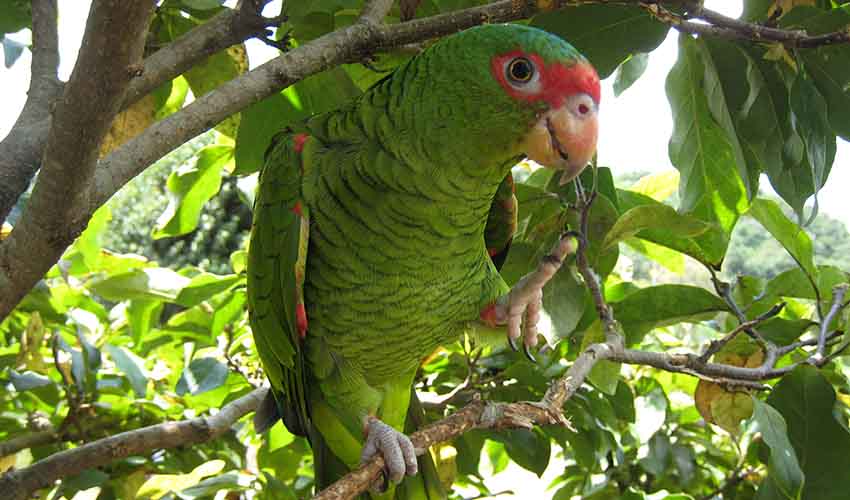
A striking and distinctive parrot native to the Atlantic forests of southeastern Brazil. It gets its name from the bright red feathers that form a bold ring around its eyes, giving the impression that the bird is wearing colorful spectacles. This red facial marking contrasts beautifully with its mostly green body, while touches of blue on the wings and darker shades on the tail add depth to its appearance. Medium-sized and sturdy, the red-spectacled amazon has a strong, curved beak and alert, intelligent eyes. Its loud, rolling calls are a familiar sound in forested areas where the species still survives.
This parrot is closely tied to forest habitats, especially moist lowland and mountain forests. It spends much of its time moving through the canopy in search of fruits, seeds, berries, and flowers. By feeding on a wide variety of plants, the red-spectacled amazon helps spread seeds and supports forest regeneration. It is a strong flyer and often travels between feeding areas and roosting sites, sometimes gathering in large flocks. At dawn and dusk, groups may be seen flying together, filling the air with noise and flashes of green and red as they move between forest patches.
What makes the red-spectacled amazon especially notable is how strongly its fate is linked to the Atlantic Forest, one of the most threatened ecosystems in the world. As forests have been cleared and fragmented, the parrot’s population has declined, making it increasingly rare in some areas. Because of this, the species has become a symbol of conservation efforts to protect remaining forest fragments and reconnect habitats.
Distribution
 Argentina
 Brazil
 Paraguay
Anything we've missed?
Help us improve this page by suggesting edits. Glory never dies!
Suggest an editGet to know me
Terrestrial / Aquatic
Altricial / Precocial
Polygamous / Monogamous
Dimorphic (size) / Monomorphic
Active: Diurnal / Nocturnal
Social behavior: Solitary / Pack / Flock
Diet: Carnivore / Frugivore / Omnivore / Piscivorous / Insectivore
Migratory: Yes / No
Domesticated: Yes / No
Dangerous: Yes / No




