


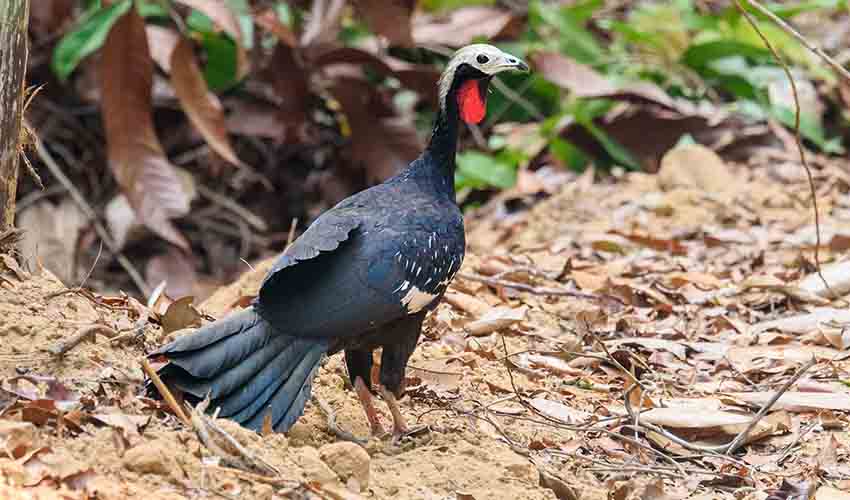
If you are familiar with typical guans—which often blend into the shadows with muted brown, olive, or grey feathers to avoid predators—the Red-throated piping guan completely breaks that mold. Its most distinct physical characteristic is, of course, the bright, bare patch of vivid red skin hanging at its throat, known as a wattle. This vibrant splash of color is framed by a striking white crest on its head and large, starkly contrasting white patches on its otherwise glossy black wings. When comparing it to its close relatives, like the Blue-throated piping guan, that brilliant red throat is the key giveaway.
Beyond its beautiful appearance, this bird is famous for a truly spectacular and unusual behavior that gives it the “piping” part of its name. While they do make high-pitched whistling or piping vocalizations, their most impressive sound does not come from their throats at all. During the breeding season, males perform a dramatic display flight where they launch themselves across the canopy and rapidly beat their specially shaped wing feathers together. This creates a loud, mechanical whirring or rattling sound, almost like a wooden instrument being shaken.
For anyone looking to measure the health of a rainforest ecosystem or establish vital conservation metrics, the Red-throated piping guan is a perfect indicator species. They are highly sensitive to human disturbance and rely heavily on vast, unbroken stretches of pristine forest to survive. Because they are almost exclusively canopy dwellers who rarely ever touch the ground, their entire lives revolve around the fruit, flowers, and occasionally insects found in the highest branches. As they travel for miles to forage for their favorite meals, they swallow the seeds whole and drop them far from the parent tree.
Distribution
 Bolivia
 Brazil
Anything we've missed?
Help us improve this page by suggesting edits. Glory never dies!
Suggest an editGet to know me
Terrestrial / Aquatic
Altricial / Precocial
Polygamous / Monogamous
Dimorphic (size) / Monomorphic
Active: Diurnal / Nocturnal
Social behavior: Solitary / Pack / Herd
Diet: Carnivore / Herbivore / Omnivore / Piscivorous / Insectivore
Migratory: Yes / No
Domesticated: Yes / No
Dangerous: Yes / No




