


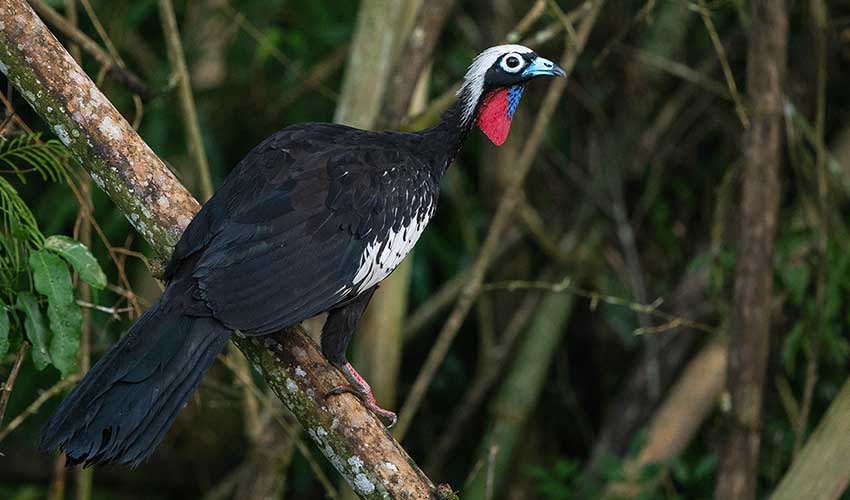
A large, elegant bird of South America’s Atlantic Forest, with a look that is both classy and memorable. It is mostly white with a bold black forehead and crown, giving it a sharp “masked” appearance, and it often shows dark markings in the wings and tail that add contrast when it moves. A red throat patch, which can look brighter when the bird is excited, adds a final splash of color. Compared with many forest birds that flash by as quick blurs, the black-fronted piping guan can seem almost calm and dignified as it perches in the canopy, stepping carefully along branches and scanning for fruit.
This species spends much of its life in trees. It is a strong climber and a confident jumper, moving from branch to branch with a balance that makes its large body look lighter than it really is. Its diet is mostly fruit, along with buds, leaves, and seeds, and it often visits fruiting trees like a regular customer who knows the best seasonal spots. Because it eats fruit in quantity and then travels, it plays an important role in spreading seeds across the forest. In healthy habitats, birds like this help trees grow in new areas, which keeps the forest diverse and resilient.
What distinguishes the black-fronted piping guan from many other guans is its striking black-and-white pattern and its strong connection to the Atlantic Forest, one of the most threatened forest regions on Earth. Many guans are mostly brown or dark, blending into shadows, but this species looks unusually bright for a forest bird, like a white banner moving through green leaves. That bright plumage can make it easier to spot—when it still exists in an area—but it can also make it more vulnerable to hunters, especially near forest edges.
Distribution
 Argentina
 Brazil
 Paraguay
Anything we've missed?
Help us improve this page by suggesting edits. Glory never dies!
Suggest an editGet to know me
Terrestrial / Aquatic
Altricial / Precocial
Polygamous / Monogamous
Dimorphic (size) / Monomorphic
Active: Diurnal / Nocturnal
Social behavior: Solitary / Pack / Herd
Diet: Carnivore / Herbivore / Omnivore / Piscivorous / Insectivore
Migratory: Yes / No
Domesticated: Yes / No
Dangerous: Yes / No




