


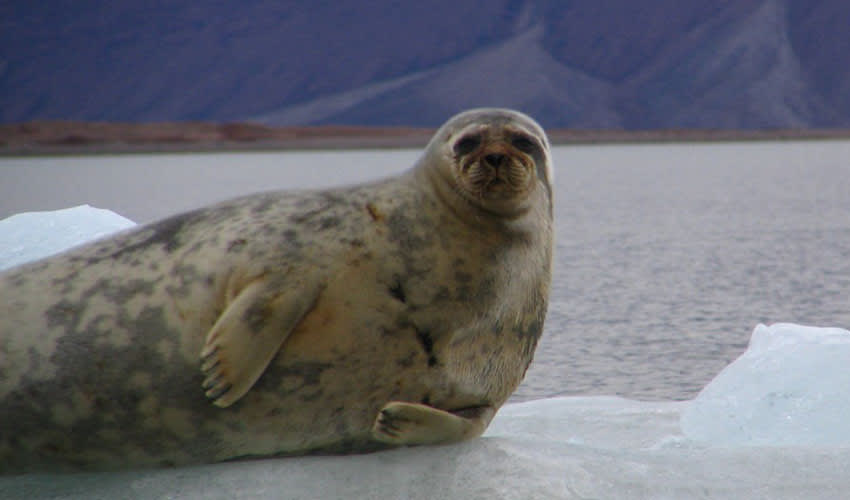
The ringed seal (Pusa hispida) is the smallest and arguably the most ice-loving of all the true seals, perfectly built for life in the Arctic’s frozen seas and sub-Arctic coastlines. Compact, round, and streamlined, they usually measure around 1.5 meters (5 feet) long and weigh 50–70 kilograms (110–155 lbs). Their name comes from the distinctive pale rings scattered across their darker gray-brown coat — a subtle but beautiful pattern that blends into icy shadows.
Ringed seals rely on sea ice more than almost any other seal. They carve and maintain breathing holes in the ice using strong claws — a behavior essential in a world where the ocean freezes solid for much of the year. In late winter, females build snow caves (known as lairs) on top of the ice, where they give birth to fluffy white pups. These shelters protect young seals from freezing winds and hungry Arctic predators like polar bears and foxes. Pups grow quickly, packing on blubber thanks to rich maternal milk, and soon shed their snowy coats for sleek gray fur.
Under the ice, ringed seals are swift and agile. They feed on small fish, crustaceans, and zooplankton, darting and twisting through icy waters with effortless grace. They can dive for 20–45 minutes and reach depths of over 300 meters (1,000 feet), though most dives are shallower, focused on rich feeding zones near the ice edge. Despite their solitary nature, they vocalize underwater with trills, whistles, and low growls, especially during mating season — an eerie underwater chorus few people ever hear.
Ringed seals play a central role in the Arctic food web, serving as the primary prey for polar bears, which depend on them for survival. Indigenous Arctic communities have also historically relied on them for food, clothing, and tools, forming a deep cultural connection with the species.
Distribution
 Arctic Ocean
 Atlantic Ocean
 Pacific ocean
 Baltic Sea
Bering Sea
Chukchi Sea
Baltic Sea
Bering Sea
Chukchi Sea Canada
 China
China Denmark
 Estonia
 Faroe Islands
 Finland
 France
 Germany
 Greenland
 Iceland
 Japan
Japan Latvia
 Lithuania
 Norway
 Poland
 Portugal
 Russia
Svalbard
Russia
Svalbard Sweden
 United Kingdom
 United States
Anything we've missed?
Help us improve this page by suggesting edits. Glory never dies!
Suggest an editGet to know me
Terrestrial / Aquatic
Altricial / Precocial
Polygamous / Monogamous
Dimorphic (size) / Monomorphic
Active: Diurnal / Nocturnal
Social behavior: Solitary / Pack / Herd
Diet: Carnivore / Herbivore / Omnivore / Piscivorous / Insectivore
Migratory: Yes / No
Domesticated: Yes / No
Dangerous: Yes / No




