


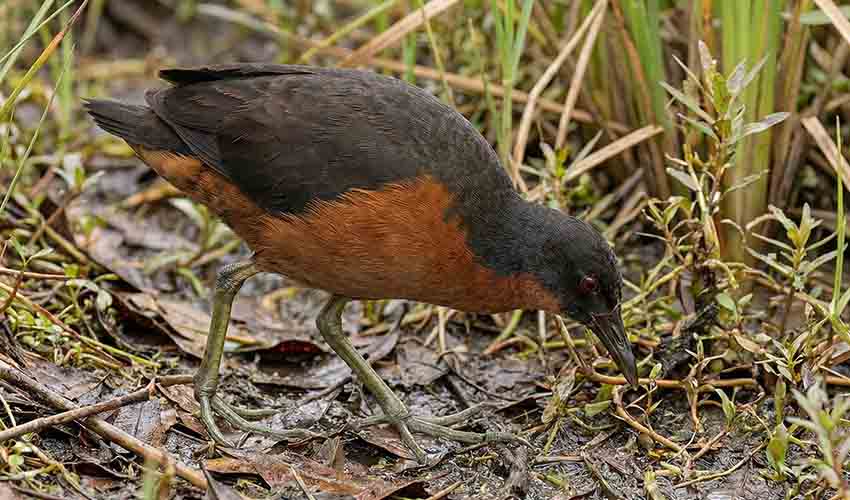
A tiny, shy wetland bird that many people never notice even when it’s nearby. It lives in parts of South and Southeast Asia, usually in places that look messy and overgrown—thick reeds, grassy marsh edges, wet rice fields, and muddy ditches with lots of cover. It’s small and round-bodied with short wings and strong legs, built more for sneaking than for flying. The “rusty-flanked” name comes from the warm, reddish-brown coloring along its sides, which stands out against its darker back and helps it blend perfectly with dried grasses and leaf litter. Like many crakes, it’s a master of staying hidden: it prefers to slip through vegetation like a mouse rather than show itself in open water.
Rusty-flanked Crakes often move with quick, careful steps, weaving between stems, stopping suddenly, then darting again. They can swim if they have to, but they usually choose the safer option—staying at the edge where plants are thick. They are also more likely to run than fly. If startled, they might burst into a short, low flight for a few seconds, then drop back into cover and vanish. Because of this, people often detect them by sound instead of sight. Their calls can be sharp and repetitive, sometimes sounding like quick clicks or short notes that seem to come from deep inside the reeds.
In terms of food, the Rusty-flanked Crake is an active forager. It searches the ground and shallow mud for small insects, worms, tiny snails, and other little creatures, and it may also take seeds or plant bits when available. This diet makes it a helpful part of wetland life, quietly keeping insect numbers in check. It’s also a bird of timing: it tends to be most active at dawn and dusk, when light is low and it feels safer from predators. When breeding season comes, it keeps its nest well hidden—usually tucked into dense grass or low vegetation near water.
Distribution
 Venezuela
 Official estimate
Anything we've missed?
Help us improve this page by suggesting edits. Glory never dies!
Suggest an editGet to know me
Terrestrial / Aquatic
Altricial / Precocial
Polygamous / Monogamous
Dimorphic/ Monomorphic (size)
Active: Diurnal / Nocturnal
Social behavior: Solitary / Pack / Herd
Diet: Carnivore / Herbivore / Omnivore / Piscivorous / Insectivore
Migratory: Yes / No
Domesticated: Yes / No
Dangerous: Yes / No




