


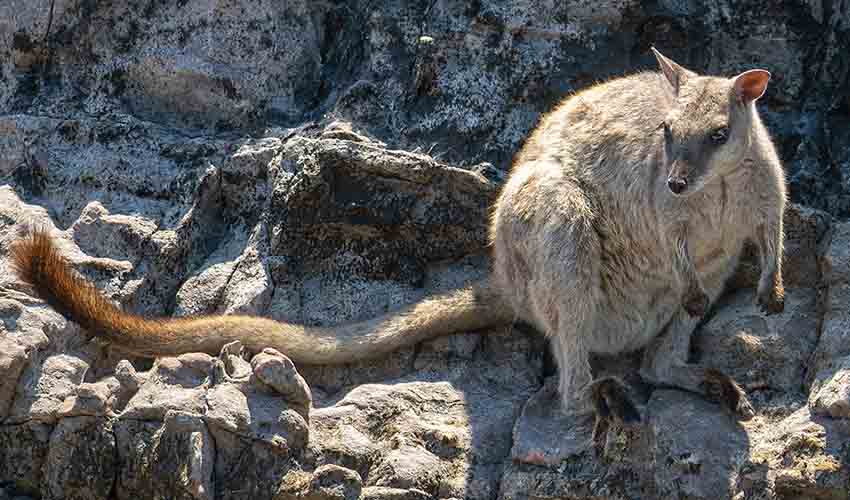
Instead of living on open grasslands like many bigger macropods, it’s a cliff-and-boulder specialist, spending its life among rugged sandstone outcrops, rocky ridges, and broken terrain in northern Australia. Its body is compact and springy, with strong back legs for powerful leaps, a long tail that works like a balancing pole, and hands that can grip and brace against rough rock. The “short-eared” part is a real clue to its identity: its ears are noticeably shorter than those of many other wallabies, giving it a rounded, sturdy look that matches its tough environment.
Rock-wallabies as a group can look confusingly similar—many are brownish, striped, or subtly patterned—so details matter. The short-eared rock-wallaby tends to have a softer, more uniform coat, often gray-brown to sandy-brown, with less dramatic striping than some of its relatives. Its smaller ears can help reduce heat gain and avoid snagging in tight crevices, and its stocky build helps it spring between ledges without wasting energy. It’s also strongly tied to the “rocky refuges” of the north: places where shade, cracks, and caves offer protection from heat and predators. In a way, it’s a wallaby that’s chosen the world’s toughest living room—stone furniture, narrow doorways, and lots of vertical space.
Life on the rocks shapes everything it does. When it feeds, it often ventures out from rocky shelter to nibble on grasses, leaves, and shrubs, then quickly returns to the safety of boulders if danger appears. Those rocks aren’t just scenery—they’re a survival tool. In the hottest parts of the day, rock-wallabies can rest in cool crevices where the temperature stays lower than the sun-baked open ground. Their feet and claws are adapted for traction, and their tail is more than decoration: it helps them “steer” mid-leap and stick landings on uneven surfaces.
Distribution
 Australia
 Official estimate
Anything we've missed?
Help us improve this page by suggesting edits. Glory never dies!
Suggest an editGet to know me
Terrestrial / Aquatic
Altricial / Precocial
Polygamous / Monogamous
Dimorphic (size) / Monomorphic
Active: Diurnal / Nocturnal
Social behavior: Solitary / Pack / Herd
Diet: Carnivore / Herbivore / Omnivore / Piscivorous / Insectivore
Migratory: Yes / No
Domesticated: Yes / No
Dangerous: Yes / No




