


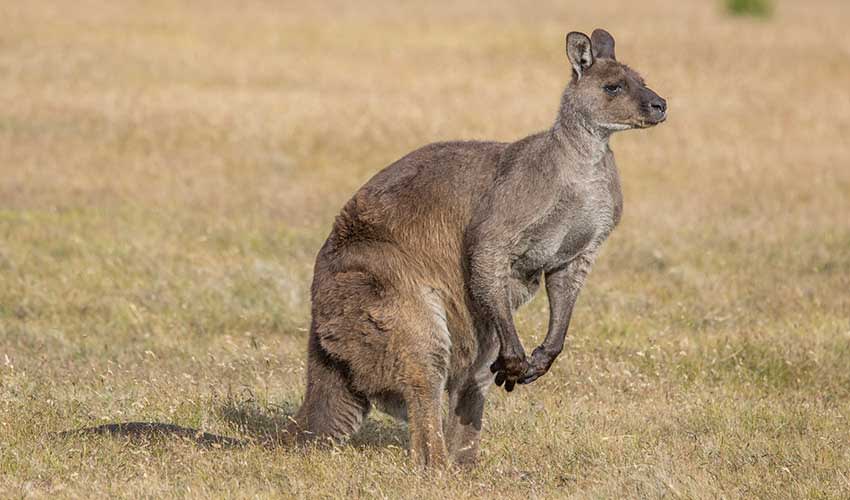
A classic image of Australia comes to life: a big, powerful marsupial with a soft grey-brown coat, long ears and an impossibly strong tail that acts like a third leg. Large males have muscular chests and shoulders, while females are noticeably smaller and lighter. Their fur ranges from pale grey to chocolate brown, with a paler throat, chest and belly and a darker face and muzzle. Up close, you can see that the muzzle is covered in fine hair rather than bare skin, and in older males, the forearms and chest can look especially bulky, built for holding and wrestling rivals. When a western grey kangaroo sits back on its haunches, tail on the ground and front paws resting lightly, it has a calm, almost contemplative look—until it suddenly springs away in a powerful series of hops.
This species lives across much of southern Australia, from coastal Western Australia through South Australia into western Victoria and large parts of the Murray–Darling basin. It prefers open woodlands, grassy plains, mallee scrub and farmland edges, rather than dense forest or true desert. Western grey kangaroos are mainly crepuscular and nocturnal, spending the hotter parts of the day resting in shade under trees or shrubs and coming out in the late afternoon, evening and night to graze.
Their diet is built around grasses and low herbs, with some leaves from shrubs and low trees mixed in. As they feed, they use their tail as a third support, leaning forward on their front paws and snipping grass with their strong incisors. Like other kangaroos, they have a complex, chambered stomach with microbes that help them break down fibrous plant material, playing a role in the ecosystem similar to grazing deer or antelope on other continents.
Distribution
 Australia
 Official estimate
Anything we've missed?
Help us improve this page by suggesting edits. Glory never dies!
Suggest an editGet to know me
Terrestrial / Aquatic
Altricial / Precocial
Polygamous / Monogamous
Dimorphic (size) / Monomorphic
Active: Diurnal / Nocturnal
Social behavior: Solitary / Pack / Mob
Diet: Carnivore / Herbivore / Omnivore / Piscivorous / Insectivore
Migratory: Yes / No
Domesticated: Yes / No
Dangerous: Yes / No




