


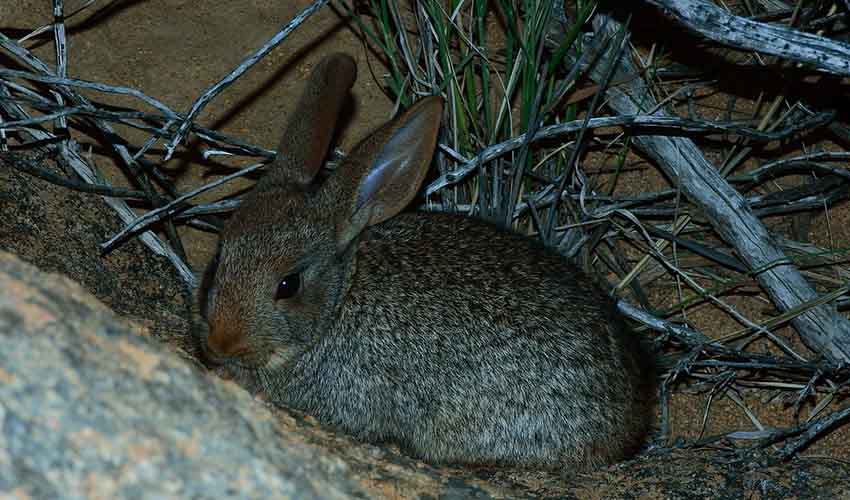
A shy, rock-loving hare found across parts of southern Africa, especially in rocky hills, escarpments, and stony slopes. It’s roughly the size of a small house cat, with long legs, big eyes, and long ears that give it that classic “hare” look. Its fur is a warm mix of reddish-brown and grey on the back, with a lighter, often whitish belly, so it blends in beautifully with sun-baked stones and dry grass. The tail is usually reddish or brown on top with a darker tip, and paler underneath, like a little flag that shows when it runs and disappears when it hunkers down.
While many hares dash across open fields, this one prefers broken ground: boulders, ledges, and rock piles where it can slip into cracks at the first sign of trouble. By day, it usually hides in rock crevices, under overhangs, or in thick bushes wedged between stones, often using the same safe spots again and again. At dusk, it becomes active, hopping quietly out to feed on grasses, small herbs, and fresh shoots. It especially likes green regrowth after rain or fire, turning burned or nibbled hillsides into new salad bars. Its long ears work like little cooling fans and sound catchers at the same time—helping it lose excess heat and listen for owls, jackals, or caracals hunting in the dark.
Smith’s red rock hare is usually a loner, but that doesn’t mean its life is empty. Most of the time, you’ll see a single animal or maybe a female with a youngster, although several hares may feed in the same general area on a good night. Like other hares, it doesn’t dig burrows the way rabbits do. Instead, it relies on those tight, rocky hideouts and its ability to freeze completely still.
Distribution
 Kenya
Kenya Malawi
 Namibia
 South Africa
 Tanzania
 Zambia
Anything we've missed?
Help us improve this page by suggesting edits. Glory never dies!
Suggest an editGet to know me
Terrestrial / Aquatic
Altricial / Precocial
Polygamous / Monogamous
Dimorphic (size) / Monomorphic
Active: Diurnal / Nocturnal
Social behavior: Solitary / Pack / Herd
Diet: Carnivore / Folivore / Omnivore / Piscivorous / Insectivore
Migratory: Yes / No
Domesticated: Yes / No
Dangerous: Yes / No




