


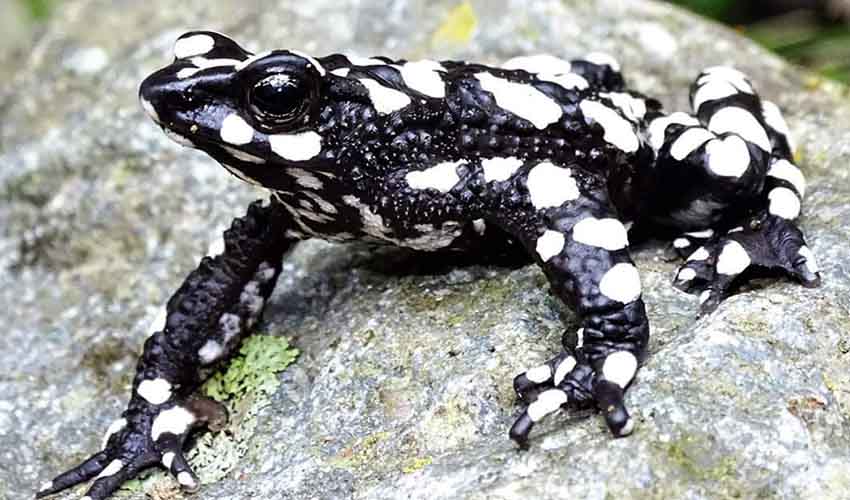
A tiny jewel of Colombia’s cloud forests that looks like it leapt straight from a dream. Covered in a constellation of bright blue spots on a deep black body, this striking creature truly lives up to its cosmic name. Endemic to the Sierra Nevada de Santa Marta, an isolated mountain range on Colombia’s Caribbean coast, the starry night toad is visually breathtaking and a symbol of hope and rediscovery. For nearly three decades, scientists believed it had gone extinct—until it miraculously reappeared in 2016, proving that some wonders of nature refuse to fade away.
The starry night toad is small and delicate. Its most distinctive feature is its iridescent blue pattern, which looks like stars scattered across a night sky. This pattern isn’t just for beauty—it may serve as camouflage among the mossy, lichen-covered rocks of its mountain habitat or as a warning signal to predators that it’s toxic. Like other members of the genus Atelopus (often called harlequin toads), it produces skin toxins that help deter predators, making it a master of both beauty and defense. Its slender limbs and smooth skin give it a delicate, almost ethereal appearance, as if it were painted by starlight.
The toad’s home, the Sierra Nevada de Santa Marta, is one of the world’s most biologically unique places, often called a “mountain island” because of its isolation from the Andes. The starry night toad lives along clear, fast-flowing mountain streams where the cool, humid environment supports the mosses and fungi it depends on. Like other harlequin toads, it has a fascinating life cycle tied to the rhythms of rain and stream flow.
Distribution
 Colombia
Anything we've missed?
Help us improve this page by suggesting edits. Glory never dies!
Suggest an editGet to know me
Terrestrial / Aquatic
Altricial / Precocial
Polygamous / Monogamous
Dimorphic (size) / Monomorphic
Active: Diurnal / Nocturnal
Social behavior: Solitary / Pack / Herd
Diet: Carnivore / Herbivore / Omnivore / Piscivorous / Insectivore
Migratory: Yes / No
Domesticated: Yes / No
Dangerous: Yes / No




