


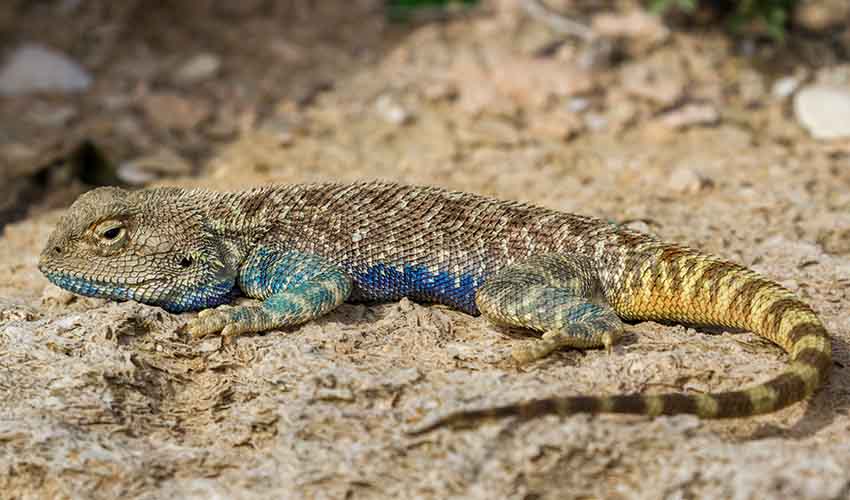
Found across Central Asia—including Kazakhstan, Iran, Afghanistan, and parts of Russia and China—this reptile thrives in dry steppes, rocky plains, and semi-desert landscapes where few creatures dare to live. Its body is compact and covered with rough, sand-colored scales that help it blend seamlessly into the arid ground. This camouflage is so effective that predators often pass by without noticing it at all. Its short legs and broad, flattened body make it excellent at soaking up heat from the sun, while its strong claws allow it to dig shallow burrows where it can escape the scorching midday heat.
One of the most striking features of the steppe agama is its ability to change color depending on its mood, temperature, and environment. When calm or resting, it usually appears dusty brown or grayish, blending into the sand. But when it’s excited—especially during the breeding season—males can display brilliant hues of orange, yellow, or even blue on their throats and sides. These flashes of color aren’t just for beauty; they play a key role in communication. Males use them to attract females and warn rivals to stay off their territory. They also perform head-bobbing and push-up displays, much like small dragons asserting dominance.
The steppe agama is mostly active during the day, spending its mornings basking in the sun to warm up before heading out to hunt. Its diet consists mainly of insects like beetles, ants, and grasshoppers, though it occasionally eats small plants or seeds. It relies on keen eyesight and quick reflexes to catch prey, darting across the ground with surprising speed for such a small creature. When threatened, it can flatten its body against the ground to hide or dash into its burrow in the blink of an eye.
Distribution
 Afghanistan
 China
China Iran
Iran Kazakhstan
 Kyrgyzstan
 Russia
 Tajikistan
 Turkmenistan
 Uzbekistan
Anything we've missed?
Help us improve this page by suggesting edits. Glory never dies!
Suggest an editGet to know me
Terrestrial / Aquatic
Altricial / Precocial
Polygamous / Monogamous
Dimorphic (size) / Monomorphic
Active: Diurnal / Nocturnal
Social behavior: Solitary / Pack / Herd
Diet: Carnivore / Herbivore / Omnivore / Piscivorous / Insectivore
Migratory: Yes / No
Domesticated: Yes / No
Dangerous: Yes / No




