


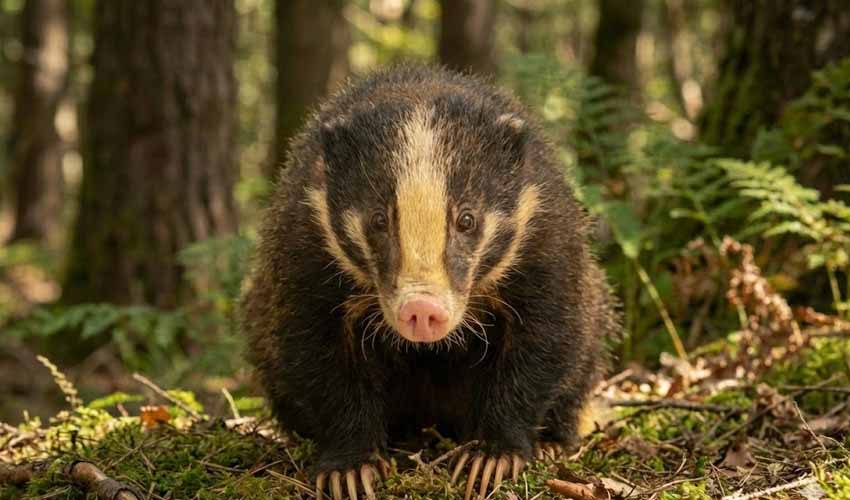
A sturdy little digger with a wonderfully odd “pig-nose” personality, found only on the Indonesian island of Sumatra. It has a stocky body, short powerful legs, and strong front claws that look made for excavation work. Its most distinctive feature is its long, bare snout, which it uses to sniff and shove through soil and leaf litter like a tiny forest bulldozer. Compared with other hog badgers, it’s generally the smallest, and it often appears darker overall—more deep brown than pale—an outfit that suits the shadowy forests it calls home. Because it lives in a warm, equatorial region, its fur can be less thick and less “puffy” than that of hog badgers from cooler regions, giving it a slightly sleeker, more streamlined look.
What truly sets the Sumatran hog badger apart from its close relatives is where it lives: the mountains. Instead of roaming widely across mainland Asia, it is tied to Sumatra’s highlands, especially the long spine of mountains that runs down the island. It’s a creature of cool, misty elevations—montane forests, cloud-forest edges, and open high meadows—places where mornings can feel chilly even in the tropics. While the northern hog badger ranges far across parts of East and South Asia, and the greater hog badger spans broader areas of mainland Southeast Asia, the Sumatran hog badger is a true island specialist.
In daily life, it behaves like a determined night-shift forager. It spends much of its time on the ground, nose down, searching for earthworms, insects, and other small creatures hidden under the surface. The routine is almost rhythmic: sniff, scrape, push the snout forward, dig again—repeat until it hits the jackpot. It will also eat roots, tubers, and fallen fruit when available, which makes it a flexible eater that can cope with seasonal changes in what the mountain offers. It tends to be solitary and can be surprisingly cautious, slipping into cover quickly when disturbed.
Distribution
 Indonesia
Anything we've missed?
Help us improve this page by suggesting edits. Glory never dies!
Suggest an editGet to know me
Terrestrial / Aquatic
Altricial / Precocial
Polygamous / Monogamous
Dimorphic (size) / Monomorphic
Active: Diurnal / Nocturnal
Social behavior: Solitary / Pack / Herd
Diet: Carnivore / Herbivore / Omnivore / Piscivorous / Insectivore
Migratory: Yes / No
Domesticated: Yes / No
Dangerous: Yes / No




