


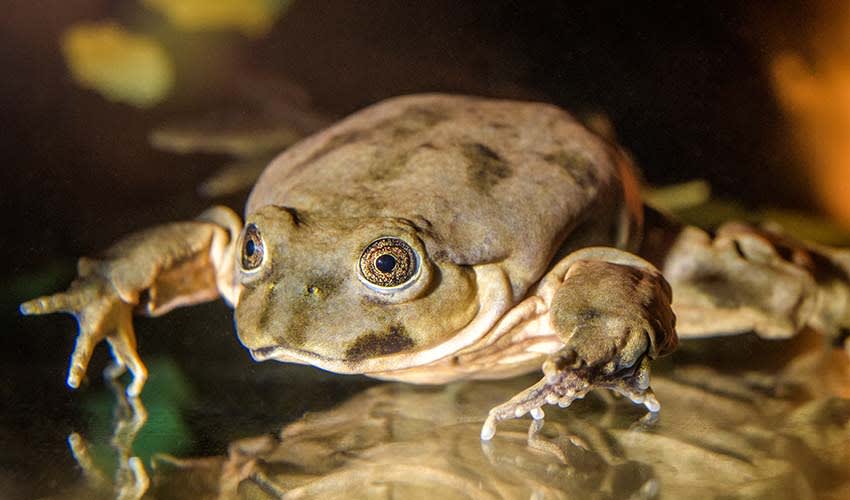
One of the most unusual frogs in the world. It lives in and around Lake Titicaca, a huge high-altitude lake in South America, between Peru and Bolivia. What makes this frog stand out right away is its loose, wrinkly skin. Because of this, it has sometimes been given the funny nickname “scrotum frog.” The name sounds silly, but the wrinkles are actually one of the frog’s greatest survival tools. Since Lake Titicaca sits high in the mountains, its water has less oxygen than that of many lower lakes. The frog’s extra skin folds increase its surface area, helping it take in oxygen directly from the water.
Unlike many frogs that spend a lot of time hopping on land, the Titicaca water frog is mostly aquatic, which means it spends most of its life in water. It has a wide, flat body, strong back legs, and large feet that help it move along the lake bottom. Instead of being brightly colored, it is usually gray, olive, brown, or greenish, which helps it blend in with rocks, mud, and underwater plants. This hidden look is very useful because the frog can rest quietly underwater without drawing attention. Compared with many other frogs that jump around ponds or call loudly from plants, this species is more like a secretive lake-dweller built for life below the surface.
One of the coolest things about the Titicaca water frog is that it can stay underwater for long periods. It may even do little “push-up” movements on the lake bottom to help water flow over its skin, allowing it to absorb more oxygen. This is a clever trick for surviving in cold, high-mountain water. It mostly eats small water animals such as insects, worms, snails, and tiny crustaceans. Because it lives in such a special place, it is very different from frogs that can move easily between many ponds or forests. The Titicaca water frog is closely tied to its lake home.
Distribution
 Bolivia
 Peru
PeruAnything we've missed?
Help us improve this page by suggesting edits. Glory never dies!
Suggest an editGet to know me
Terrestrial / Aquatic
Altricial / Precocial
Polygamous / Monogamous
Dimorphic (size) / Monomorphic
Active: Diurnal / Nocturnal
Social behavior: Solitary / Pack / Herd
Diet: Carnivore / Herbivore / Omnivore / Piscivorous / Insectivore
Migratory: Yes / No
Domesticated: Yes / No
Dangerous: Yes / No




