


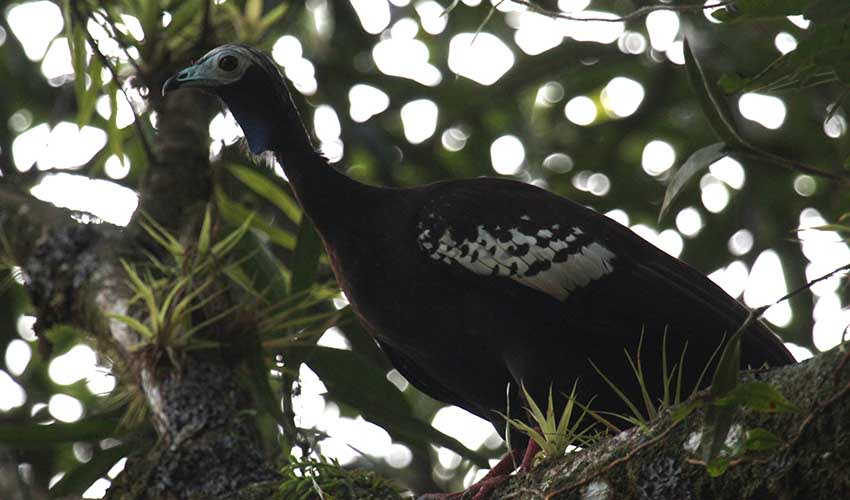
Locally known as the “pawi,” it is one of the most endangered birds in the Caribbean and an irreplaceable treasure of Trinidad’s Northern Range forests. This medium-sized, arboreal bird has a sleek blackish body with a subtle greenish sheen, white flecking on the wings, a white crest, and a pale bluish-gray wattle at the base of its bill. Its quiet, flute-like whistles and soft wingbeats make it a gentle, almost ghost-like presence in the rainforest canopy. Unlike loud chachalacas or bulky curassows, the pawi moves with quiet grace, foraging carefully among branches and pausing frequently to check its surroundings — a cautious behavior shaped by centuries of predation pressure in dense rainforest.
The Trinidad piping guan is fruit-focused, feeding mainly on berries and seeds from native trees such as ficus and palms, along with leaves and flowers. Because it swallows fruit whole and disperses seeds across long distances, it plays a critical ecological role as a forest regenerator. It spends most of its life high above the forest floor, traveling in pairs or small family groups, roosting in tall trees, and using its strong legs and feet to hop along branches. When disturbed, it usually freezes or slips quietly deeper into foliage rather than flying off dramatically — a survival strategy that makes it notoriously difficult to spot.
Unfortunately, this species is critically endangered and restricted almost entirely to Trinidad (historically, it may have occurred on Tobago, but there are no confirmed recent records). The pawi’s decline is linked primarily to overhunting in the 20th century and ongoing habitat loss and fragmentation, particularly from agriculture and development in foothill forests. Today, its last strongholds are remote areas of the Northern Range, including protected sites like the Morne Bleu and Brasso Seco region, though the population remains very small and vulnerable.
Distribution
 Trinidad & Tobago
 Official estimate
Anything we've missed?
Help us improve this page by suggesting edits. Glory never dies!
Suggest an editGet to know me
Terrestrial / Aquatic
Altricial / Precocial
Polygamous / Monogamous
Dimorphic (size) / Monomorphic
Active: Diurnal / Nocturnal
Social behavior: Solitary / Pack / Herd
Diet: Carnivore / Frugivore / Omnivore / Piscivorous / Insectivore
Migratory: Yes / No
Domesticated: Yes / No
Dangerous: Yes / No




