


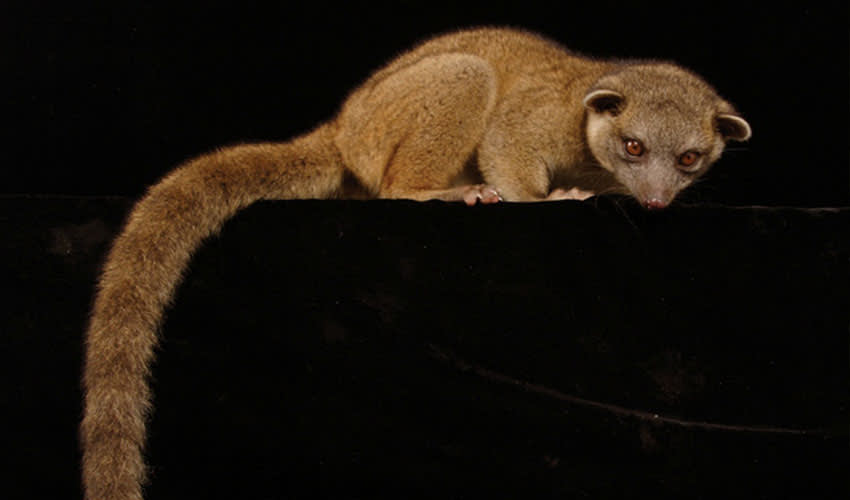
A graceful, tree-dwelling mammal that looks like it belongs in a storybook forest, even though it lives in the dense rainforests of the Americas. It has a long, slim body, short legs, and a thick, furry tail that acts like a balancing pole as it moves through branches. Its fur is usually soft and brown to gray-brown, often lighter on the face and underside, and its large, dark eyes give it a gentle, almost curious expression. Those eyes are perfectly suited for its mostly nocturnal life, helping it navigate the canopy when the forest is quiet and shadowed.
What makes the western lowland olingo stand out from other members of its group is where it lives and how it uses its world. It is mainly found in lowland rainforests west of the Andes, and unlike relatives that prefer higher elevations, this olingo is closely tied to warm, humid lowland forest. It belongs to the same family as raccoons and coatis, but it is far more strictly arboreal than most of them. While raccoons are famous ground explorers and coatis are active daytime foragers, the western lowland olingo is a quiet, nighttime specialist of the treetops. Compared with kinkajous, which are often bulkier and have a more rounded look, olingos tend to be slimmer and more fox-like, with a sharper face and lighter, more agile build.
In daily life, the western lowland olingo behaves like a gentle but persistent forager. Fruit makes up much of its diet, and it travels from tree to tree searching for ripe offerings, using its nose and keen night vision to guide it. It will also eat insects and small animals when the chance arises, making it an adaptable feeder rather than a strict fruit-eater. During the day, it rests high in trees, tucked into leafy cover or natural hollows, where it is well hidden from both predators and human eyes.
Distribution
 Colombia
 Ecuador
 Panama
Anything we've missed?
Help us improve this page by suggesting edits. Glory never dies!
Suggest an editGet to know me
Terrestrial / Aquatic
Altricial / Precocial
Polygamous / Monogamous
Dimorphic (size) / Monomorphic
Active: Diurnal / Nocturnal
Social behavior: Solitary / Pack / Herd
Diet: Carnivore / Herbivore / Omnivore / Piscivorous / Insectivore
Migratory: Yes / No
Domesticated: Yes / No
Dangerous: Yes / No




