


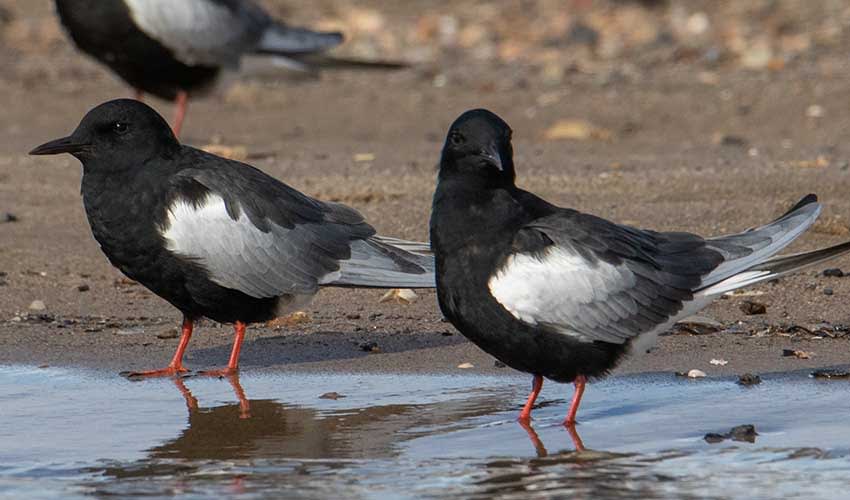
During the breeding season, this bird is absolutely stunning and impossible to mistake for any of its relatives. While other terns usually have white bodies and black caps, the white-winged tern does the exact opposite: it sports a deep, velvety jet-black body that contrasts sharply with its namesake “white wings.” To finish off this high-fashion look, it has a bright red beak and matching red legs that look like tiny, stylish boots.
While many of its cousins are battling ocean waves, this bird is a specialist of freshwater marshes, lakes, and even flooded rice paddies. Because of this, it has developed a very specific and elegant way of eating. You won’t see this bird “crash-diving” into deep water like a clumsy stone. Instead, it is an elite aerial acrobat. It “hawks” for food, meaning it snatches dragonflies and other insects right out of the air with incredible precision. If it does feed from the water, it gently dips its beak to pluck a snack off the surface while staying perfectly dry.
One of the most fascinating things about this bird is its incredible “seasonal wardrobe.” While its black-and-white breeding outfit is iconic, the white-winged tern is a master of disguise. Once the summer ends, it undergoes a total transformation, shedding its dark feathers for a more conservative grey-and-white look to blend in during its long travels. And those travels are nothing short of heroic. Despite being a relatively small and delicate-looking bird, it is a world-class traveler. These birds are known to fly staggering distances, migrating from the quiet marshes of Europe and Asia to the tropical wetlands of Africa, Australia, and even the Philippines.
Distribution
 Afghanistan
 Albania
 Algeria
 Angola
 Antigua & Barbuda
 Armenia
 Australia
 Austria
 Azerbaijan
 Bahamas
 Bahrain
 Bangladesh
 Barbados
 Belarus
 Belgium
 Benin
Benin Bosnia And Herz.
 Botswana
 Brunei
 Bulgaria
 Burkina Faso
 Burundi
 Cambodia
 Cameroon
 Canada
 Central Af. Rep.
 Chad
Chad China
China Cocos Is. (Keeling)
 Congo-Brazzaville
 Croatia
 Cyprus
 Czechia
 Côte D’ivoire
 DR Congo (Kinshasa)
 Denmark
 Djibouti
 Dominica
 East Timor
 Egypt
Egypt Equatorial Guinea
 Eritrea
 Estonia
 Eswatini
 Ethiopia
 Faroe Islands
 Finland
 France
 Gabon
Gabon Gambia
 Georgia
 Germany
 Ghana
Ghana Gibraltar
 Greece
Guadeloupe
Greece
Guadeloupe Guam
Guam Guinea-Bissau
 Guinea
 Hong Kong
 Hungary
 Iceland
 India
India Indonesia
 Iran
Iran Iraq
Iraq Ireland
 Israel
 Italy
Italy Japan
Japan Jordan
 Kazakhstan
 Kenya
Kenya Korea
Korea Kuwait
 Laos
Laos Latvia
 Lebanon
 Lesotho
 Liberia
 Libya
Libya Lithuania
 Luxembourg
 Madagascar
 Malawi
 Malaysia
 Maldives
 Mali
Mali Malta
Malta Marshall Islands
Martinique
Marshall Islands
Martinique Mauritania
 Micronesia
 Moldova
 Mongolia
 Montenegro
 Montserrat
 Morocco
 Mozambique
 Myanmar
 Namibia
 Nauru
Nauru Nepal
Nepal Netherlands
 New Zealand
 Niger
Niger Nigeria
 Nort. Mariana Is.
 North Korea
 North Macedonia
 Norway
 Oman
Oman Pakistan
 Palau
Palau Papua New Guinea
 Philippines
 Poland
 Portugal
 Puerto Rico
 Qatar
Qatar Romania
 Russia
 Rwanda
Réunion
Rwanda
Réunion Saint Lucia
 Saint Vincent
 Saudi Arabia
 Senegal
 Serbia
 Seychelles
 Sierra Leone
 Singapore
 Slovakia
 Slovenia
 Solomon Islands
 Somalia
 South Africa
 South Sudan
 Spain
Spain Sri Lanka
 St. Kitts & Nevis
 Sudan
Sudan Sweden
 Switzerland
 Syria
Syria São Tomé & Príncipe
 Taiwan
 Tajikistan
 Tanzania
 Thailand
 Togo
Togo Tunisia
 Turkmenistan
 Turks & Caicos
 Turkey
 UAE
UAE US Virgin Islands
 Uganda
 Ukraine
 United Kingdom
 United States
 Uzbekistan
 Vietnam
 Yemen
Yemen Zambia
 Zimbabwe
Anything we've missed?
Help us improve this page by suggesting edits. Glory never dies!
Suggest an editGet to know me
Terrestrial / Aquatic
Altricial / Precocial
Polygamous / Monogamous
Dimorphic (size) / Monomorphic
Active: Diurnal / Nocturnal
Social behavior: Solitary / Pack / Flock
Diet: Carnivore / Herbivore / Omnivore / Piscivorous / Insectivore
Migratory: Yes / No
Domesticated: Yes / No
Dangerous: Yes / No




