


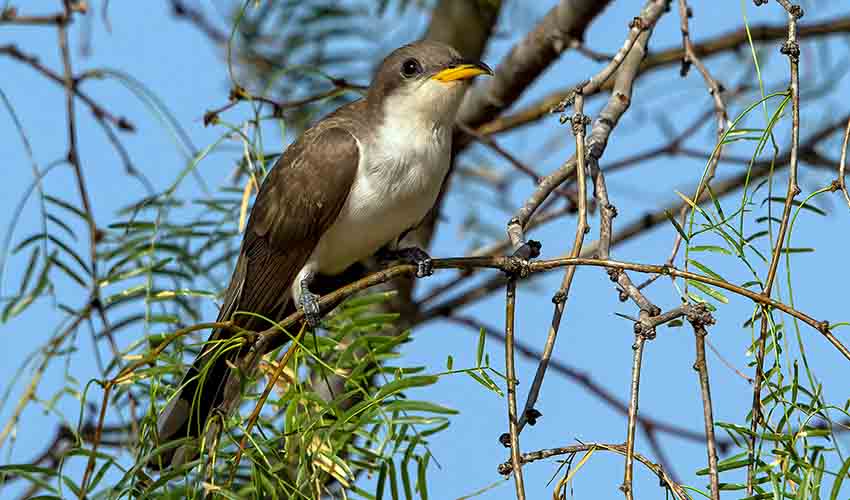
A sleek, long-tailed phantom of the eastern forests, often called the “raincrow” by those who listen for its distinctive, rattling call before a summer storm. Its most defining features are its bicolored bill—black on top with a bright, sunny yellow lower half—and the bold, white “coin” spots that decorate the underside of its long, grayish-brown tail. Unlike the black-billed cuckoo, this species also sports a flash of warm cinnamon-orange on its primary wing feathers, a secret color that is only fully visible when it takes flight or stretches its wings in the dappled sunlight.
This bird is a world-class athlete when it comes to pest control, specifically targeting the hairy caterpillars that most other birds won’t touch. It is famous for its “slash and burn” approach to tent caterpillar outbreaks, often eating as many as 100 caterpillars in a single sitting. Because these caterpillars are covered in irritating, bristly hairs, the cuckoo’s stomach eventually becomes lined with a “carpet” of bristles. To keep its digestive system functioning, the bird has evolved the incredible ability to periodically shed its entire stomach lining, coughing it up in a pellet to start fresh. This specialized diet makes the yellow-billed cuckoo a vital protector of forest health, as it can single-handedly stop an insect infestation from stripping an entire grove of trees bare.
In the world of parenting, the yellow-billed cuckoo is a bit of a “flexible” strategist. While they usually build their own thin, flat nests of twigs and raise their own chicks, they are also known for “facultative brood parasitism.” If food is exceptionally abundant—like during a massive locust or caterpillar swarm—the female may produce more eggs than she can handle. In these boom times, she will sneak her extra eggs into the nests of other birds, including robins or even other cuckoos, effectively outsourcing the childcare so she can focus on eating more.
Distribution
 Anguilla
 Antigua & Barbuda
 Argentina
 Aruba
Aruba Bahamas
 Barbados
 Belgium
 Belize
 Bermuda
 Bolivia
 Bonaire Sint Eustatius And Saba
 Brazil
 British Virgin Is.
 Canada
 Cayman Islands
 Colombia
 Costa Rica
 Cuba
Cuba Curaçao
 Denmark
 Dominica
 Dominican Republic
 Ecuador
 El Salvador
 France
 French Guiana
 Greenland
Guadeloupe
Greenland
Guadeloupe Guatemala
 Guyana
 Haiti
Haiti Honduras
 Ireland
 Italy
Italy Jamaica
Martinique
Jamaica
Martinique Mexico
 Montserrat
 Morocco
 Nicaragua
 Norway
 Panama
 Paraguay
 Peru
Peru Portugal
 Puerto Rico
 Saint Barthélemy
 Saint Lucia
 Saint Martin
 Saint Pierre
 Saint Vincent
 Sint Maarten
 St. Kitts & Nevis
 Suriname
 Trinidad & Tobago
 Turks & Caicos
 US Minor Is.
 US Virgin Islands
 United Kingdom
 United States
 Uruguay
 Venezuela
Anything we've missed?
Help us improve this page by suggesting edits. Glory never dies!
Suggest an editGet to know me
Terrestrial / Aquatic
Altricial / Precocial
Polygamous / Monogamous
Dimorphic (size) / Monomorphic
Active: Diurnal / Nocturnal
Social behavior: Solitary / Pack / Herd
Diet: Carnivore / Herbivore / Omnivore / Piscivorous / Insectivore
Migratory: Yes / No
Domesticated: Yes / No
Dangerous: Yes / No




