


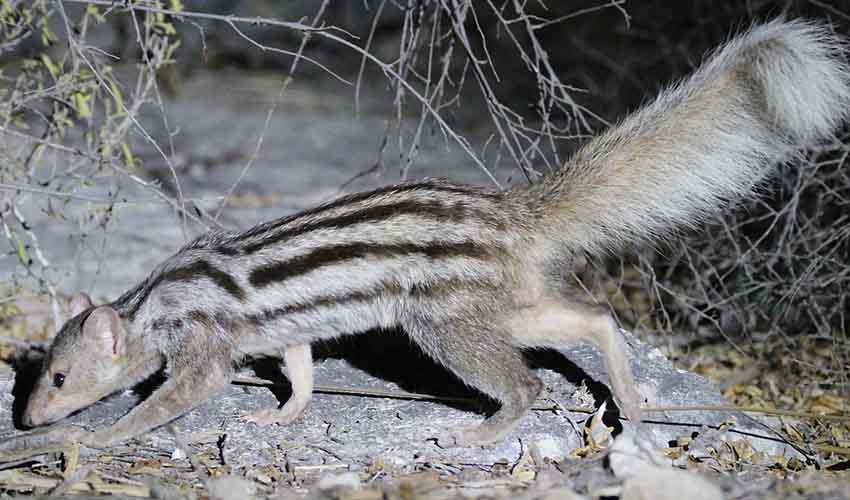
One of Madagascar’s most striking small hunters, and it stands out the moment you see it. Its coat is usually a warm reddish-brown to chestnut color, marked with bold dark stripes running across its back and sides—almost like someone brushed on racing stripes with a steady hand. Compared with many other mongooses, it tends to look a bit stockier and more “plush,” with thick fur that gives it a softer, fuller outline. Its face is pointed and alert, with quick eyes and a curious, ready-to-move posture that suits an animal built for searching, sniffing, and sudden bursts of speed through leaf litter.
What really sets it apart from other members of its mongoose family in Madagascar is its dramatic striping and forest-loving lifestyle. Many mongooses elsewhere are known for open-country roaming and bold daytime activity, but this species is more tied to wooded places, where stripes help break up its shape in dappled light. It’s also less of a “public” animal than some of its relatives—more likely to slip away quietly than put on a show. If you imagine a mongoose as a loud, fearless street fighter, the broad-striped Malagasy mongoose feels more like a stealthy forest specialist: careful, watchful, and built to vanish into a patterned background.
In day-to-day life, it behaves like a determined treasure hunter. It uses its sharp nose to track down meals that can include insects, small creatures, and other bite-sized finds hidden under leaves or tucked into rotting wood. It’s a ground-loving mover, weaving through undergrowth with confidence, but it can also climb when it needs to. One fun detail: animals that hunt this way often become experts at “leaf-litter listening”—pausing, tilting the head, and pouncing when a tiny rustle gives away something edible. If you ever hear the forest floor crackle and then suddenly go quiet, that’s the kind of moment a predator like this is made for.
Distribution
 Madagascar
Anything we've missed?
Help us improve this page by suggesting edits. Glory never dies!
Suggest an editGet to know me
Terrestrial / Aquatic
Altricial / Precocial
Polygamous / Monogamous
Dimorphic (size) / Monomorphic
Active: Diurnal / Nocturnal
Social behavior: Solitary / Pack / Herd
Diet: Carnivore / Herbivore / Omnivore / Piscivorous / Insectivore
Migratory: Yes / No
Domesticated: Yes / No
Dangerous: Yes / No




