


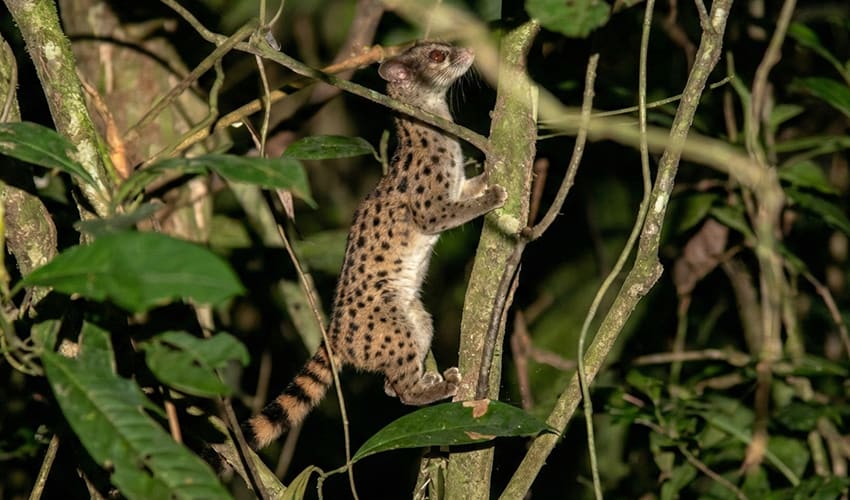
It looks a bit like a stretched-out, mini leopard crossed with a cat and a ferret: long, slim body; short legs; and a tail that can be as long as the rest of it. Its fur is yellowish or pale brown, covered with dark spots and rings, and the tail has bold bands that stand out when you finally catch a glimpse of it. Big round eyes and large ears give it a permanently surprised look, perfect for spotting and hearing the smallest rustle in the dark. Even though it’s only about the size of a small house cat and weighs less than a kilogram, it’s a confident little hunter perfectly at home in tangled branches and vines.
What makes the Central African oyan especially cool is how tree-loving it is. This animal spends most of its life above the ground, walking along branches like a tightrope artist. Its long tail works like a built-in balancing pole, helping it turn, crouch, and leap without slipping. Camera-trap studies have shown oyans padding along high branches at night, barely triggering the cameras before they vanish again into the leaves. In fact, some of the first solid records from places like Rwanda came from these hidden cameras in the canopy, surprising scientists who didn’t even know the species lived there.
The oyan’s menu is a mix of “whatever small, tasty thing the forest offers.” It eats insects, small rodents, birds, lizards, and maybe fruit now and then, snatching prey with quick pounces and sharp little teeth. Because it hunts mostly at night and in the trees, people who live near its forests can go their whole lives without seeing one.
Distribution
 Cameroon
 Central Af. Rep.
 Congo-Brazzaville
 DR Congo (Kinshasa)
 Equatorial Guinea
 Gabon
GabonAnything we've missed?
Help us improve this page by suggesting edits. Glory never dies!
Suggest an editGet to know me
Terrestrial / Aquatic
Altricial / Precocial
Polygamous / Monogamous
Dimorphic (size) / Monomorphic
Active: Diurnal / Nocturnal
Social behavior: Solitary / Pack / Herd
Diet: Carnivore / Herbivore / Omnivore / Piscivorous / Insectivore
Migratory: Yes / No
Domesticated: Yes / No
Dangerous: Yes / No




