


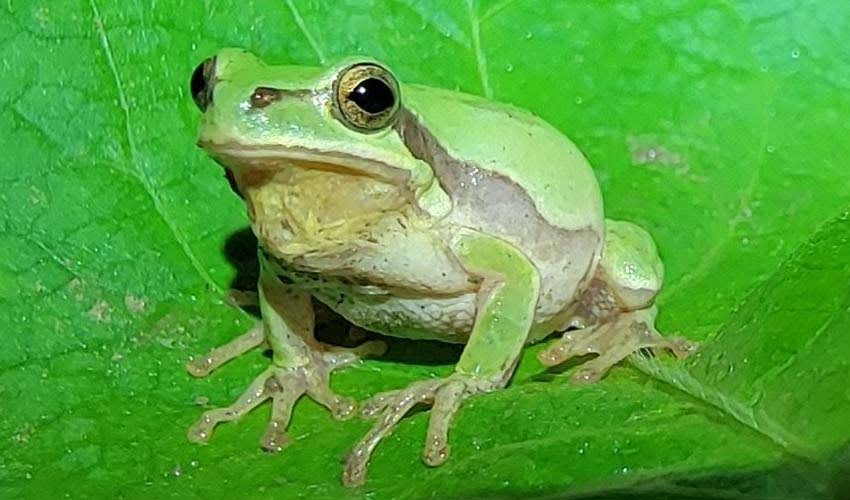
Found mainly in northern and eastern China, this species is a close relative of other Asian treefrogs like the Suweon treefrog (Dryophytes suweonensis) and the Japanese treefrog (Dryophytes japonicus) — though it has its own distinct flair. Its body is usually a lively shade of leafy green, sometimes shifting to yellowish or brown tones to match its surroundings, with a bold dark stripe running from the snout through the eye and along its side — like a little superhero mask.
One of the most impressive features of the Chinese immaculate treefrog is its adaptability. It lives comfortably in both natural wetlands and man-made habitats like rice paddies, ditches, and ponds — anywhere there’s shallow, still water for breeding. Come spring, when the nights grow warm and damp, males gather to sing their distinct, rhythmic calls, filling the air with a chorus that can sound like a blend of soft croaks and musical trills. These calls are more than just a soundtrack to the season — they help females identify mates of their own species in areas where several treefrog species may be calling at once.
The Chinese immaculate treefrog may be small, but it has the heart of a survivor. In the chilly corners of its homeland, winter can be harsh and unforgiving, yet this little frog weathers the cold with quiet determination. When the frost rolls in, it tucks itself into the earth or beneath a cozy blanket of fallen leaves, curling up and waiting patiently for spring to return with warmth and life.
Once, it could rely on lush wetlands and forest edges for shelter. But as rice fields have replaced wild landscapes, the frog has been pushed to the edges—literally. Today, many of them hibernate along the borders of rice paddies, clinging to the last scraps of suitable habitat. And now, even those thin refuges are slipping away as modern farming methods reshape the land. Rapid habitat loss and changes in farming techniques have caused this species to decline at an alarming rate, putting it on a worrying trajectory toward official endangered status in the near future.
Distribution
 China
ChinaAnything we've missed?
Help us improve this page by suggesting edits. Glory never dies!
Suggest an editGet to know me
Terrestrial / Aquatic
Altricial / Precocial
Polygamous / Monogamous
Dimorphic (size) / Monomorphic
Active: Diurnal / Nocturnal
Social behavior: Solitary / Pack / Herd
Diet: Carnivore / Herbivore / Omnivore / Piscivorous / Insectivore
Migratory: Yes / No
Domesticated: Yes / No
Dangerous: Yes / No




