


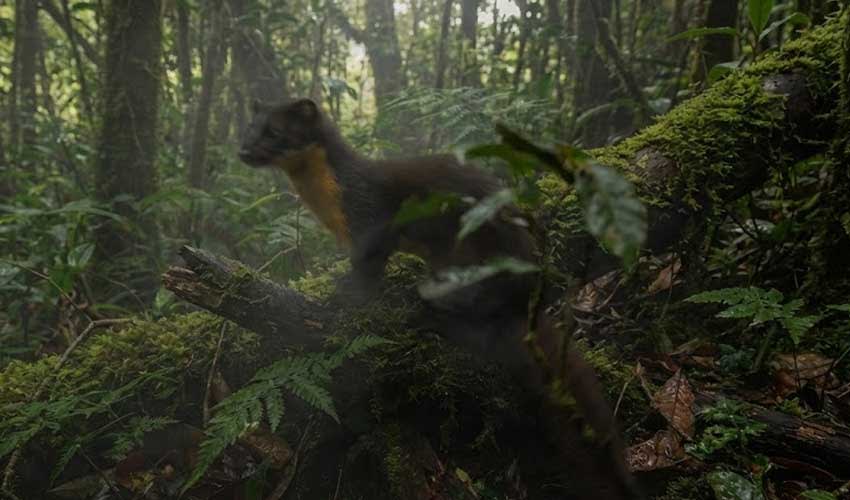
A tiny, sleek predator from the northern Andes, and it looks like it was built for slipping into places other hunters can’t go. It has the classic weasel design: a long, narrow body, short legs, a pointed face, and a tail that helps it balance and steer during fast turns. Its color pattern is one of its standout features—usually a very dark brown to nearly black back and tail, with a much paler underside that can look creamy to warm buff.
What really separates the Colombian weasel from other weasels is how incredibly rare it is in human records. Many weasel species are familiar sights in fields, forests, and farmlands across the world, but this one is known from very few confirmed locations, mostly in Colombia, with at least one confirmed record in nearby Ecuador. Because sightings are so scarce, it has a reputation as a “ghost” animal—real, but easy to miss and hard to study. It is also among the smallest meat-eating mammals, even compared with other weasels. That small size likely makes it an expert at chasing prey into tight spaces: under roots, between rocks, and into burrows where larger predators simply can’t fit.
Another thing that seems to set it apart is the kind of habitat it’s linked to. Unlike weasels that thrive in open areas or adapt easily to farmland edges, the Colombian weasel is often associated with wet, streamside environments in humid mountain forests—places where mist, moss, and rushing water shape the landscape. That “near-water” tendency is especially interesting because it hints at a lifestyle that might include hunting along banks and in dense ground cover close to streams. Some accounts even suggest it may take prey connected to water, which would be an unusual twist for such a small weasel and makes it feel like a miniature, high-speed shoreline hunter.
Distribution
 Colombia
 Ecuador
Anything we've missed?
Help us improve this page by suggesting edits. Glory never dies!
Suggest an editGet to know me
Terrestrial / Aquatic
Altricial / Precocial
Polygamous / Monogamous
Dimorphic (size) / Monomorphic
Active: Diurnal / Nocturnal
Social behavior: Solitary / Pack / Herd
Diet: Carnivore / Herbivore / Omnivore / Piscivorous / Insectivore
Migratory: Yes / No
Domesticated: Yes / No
Dangerous: Yes / No




