


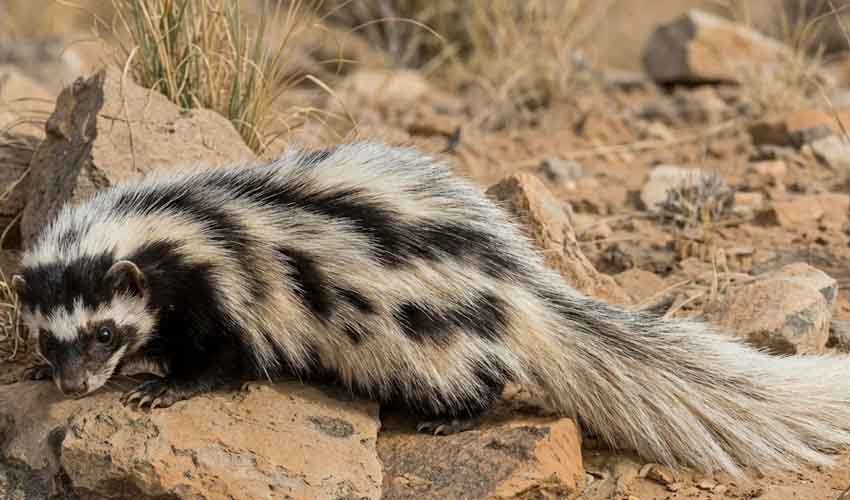
A small, fearless hunter built for life on the dry edge of the world. It has a long, low body, short legs, and a face that looks permanently alert, as if it’s always deciding whether to investigate, chase, or vanish. Its coat is the first thing people notice: bold black-and-white striping along the body, often paired with a pale or whitish head and a dark “mask” around the eyes. The stripes are more than decoration—they help break up its outline at night and in patchy moonlight, which is handy when you live in open, sandy country with little cover. Its tail is usually bushy, and when it’s excited or threatened, it can fluff the tail up to look bigger, like it’s trying to double its size in an instant.
What really distinguishes the Saharan striped polecat from its close relatives is its desert-and-semi-desert lifestyle. Many mustelids (its broader family) are tied to forests, rivers, or cooler regions, but this animal is adapted to arid landscapes across North Africa and the fringes of the Sahara, where nights can be chilly, and food can be unpredictable. Compared with the more widely known striped polecat found farther south in Africa, the Saharan species is generally associated with drier habitats and may show slightly different proportions and a paler overall look that blends better with desert tones.
In personality, it’s basically a pint-sized daredevil. The Saharan striped polecat hunts mainly at night, trotting with purpose and using its sharp nose to track down rodents, small birds, lizards, insects, and whatever else it can catch. Its long body lets it poke into burrows and crevices, and its quick bites and strong grip help it handle prey that might fight back. It also has one of the most famous defenses in the animal world: like skunks, it can release an intensely smelly spray when threatened.
Distribution
 Algeria
 Burkina Faso
 Chad
Chad Egypt
Egypt Eritrea
 Libya
Libya Mali
Mali Mauritania
 Morocco
 Niger
Niger Nigeria
 Senegal
 Sudan
Sudan Tunisia
Anything we've missed?
Help us improve this page by suggesting edits. Glory never dies!
Suggest an editGet to know me
Terrestrial / Aquatic
Altricial / Precocial
Polygamous / Monogamous
Dimorphic (size) / Monomorphic
Active: Diurnal / Nocturnal
Social behavior: Solitary / Pack / Herd
Diet: Carnivore / Herbivore / Omnivore / Piscivorous / Insectivore
Migratory: Yes / No
Domesticated: Yes / No
Dangerous: Yes / No




