


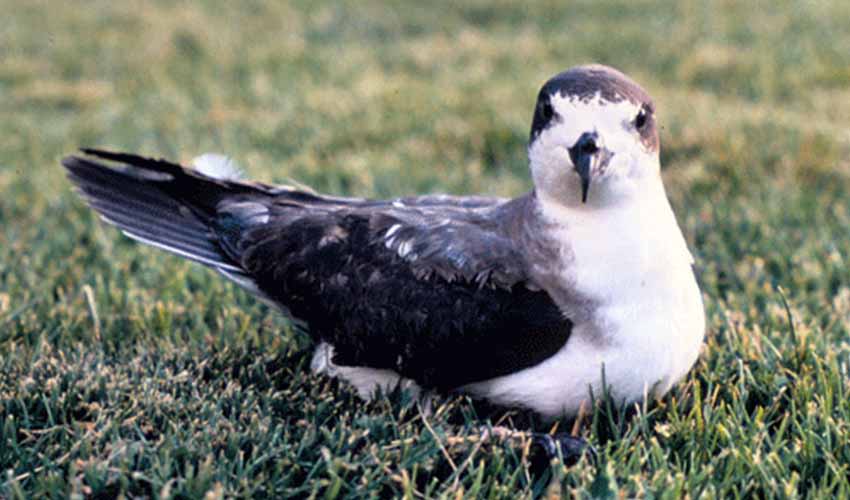
Most of its life is spent far out over the Pacific Ocean, gliding low over waves and covering huge distances in search of scattered food. It comes ashore only to breed, and it does so in a way that surprises many people: instead of nesting right by the sea, it flies inland at night to high, remote slopes on the Hawaiian Islands. There, it uses burrows or sheltered hollows in the ground, often in cool, misty places. In the air, it looks clean and powerful—long wings, a sturdy body, and a calm, sailing style that lets it travel far while barely flapping.
What makes the Hawaiian petrel stand out from other similar petrels and shearwaters in the region is a mix of looks, voice, and habits. It’s generally larger and more broad-winged than Newell’s shearwater, which is another famous Hawaiian seabird, and it tends to have a heavier, more “built for long-haul” appearance. Its coloring is also a helpful clue: Hawaiian petrels often show a mottled gray-brown top and pale underparts, with a pattern that can vary from bird to bird—some look darker and more smudged, others lighter and cleaner. Another difference is its breeding style. Hawaiian petrels are strongly tied to high-elevation nesting areas on islands such as Maui, Hawaii (Island), Kauaʻi, and Lānaʻi, where they return year after year to the same general spots.
Their daily routine is half ocean adventure, half secret nighttime commute. Adults usually fly to and from nesting sites after dark, when it’s safer and cooler, and when fewer predators are active. A pair typically raises just one chick at a time, so they invest heavily in that single youngster—taking long feeding trips out to sea, then returning with meals for the chick hidden in its burrow. At sea, the Hawaiian petrel feeds on fish and squid that come closer to the surface, especially at night.
Distribution
 French Polynesia
 Indonesia
 Japan
Japan Kiribati
 Philippines
 US Minor Is.
 United States
Anything we've missed?
Help us improve this page by suggesting edits. Glory never dies!
Suggest an editGet to know me
Terrestrial / Aquatic
Altricial / Precocial
Polygamous / Monogamous
Dimorphic (size) / Monomorphic
Active: Diurnal / Nocturnal
Social behavior: Solitary / Pack / Flock
Diet: Carnivore / Herbivore / Omnivore / Piscivorous / Insectivore
Migratory: Yes / No
Domesticated: Yes / No
Dangerous: Yes / No




