


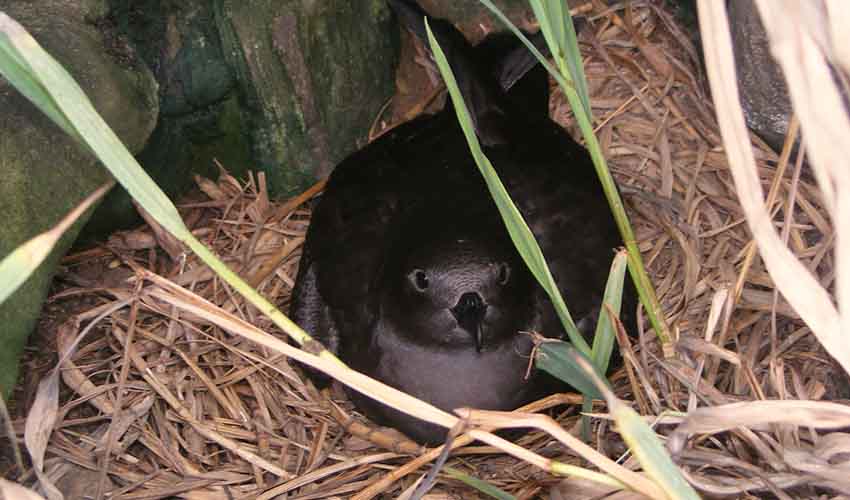
A small, ocean-roaming bird that spends most of its life far from shore, riding the winds over the open South Pacific Ocean. It comes to land mainly to breed, and it does so in one of the most isolated places imaginable: Henderson Island, part of the Pitcairn Islands. In the air, it’s built for efficiency—long wings, a lightweight body, and a style of flight that looks like gliding, banking, and slicing through wind rather than constant flapping. Up close, it has a smart, “storm-bird” look: dark on top, pale underneath, and a face that can seem softly shadowed, especially in low light.
Many similar petrels breed on multiple islands or in larger, more obvious colonies; the Henderson petrel’s world is narrower and more hidden. Instead of showy cliff ledges or loud, crowded nesting sites, it often uses sheltered spots on the forest floor, where it can be surprisingly hard to detect. It also has a more understated appearance than some related petrels that wear stronger contrasts, brighter patches, or more dramatic patterns. Think of it as a bird that wins by being subtle: blending into night skies, keeping a low profile on land, and slipping in and out without drawing attention.
Around the nesting areas, it’s often most active at night, when cooler air and darkness make it safer to arrive, call, and trade places at the nest. During feeding trips, it searches the sea surface for small fish and squid, sometimes keying in on places where ocean life gathers near the top. One of the most interesting things about petrels like this is how devoted they can be to the same breeding spot: after traveling enormous distances over open water, they return to the same island and often the same general nesting area, as if they carry an internal map.
Distribution
 French Polynesia
 Kiribati
 Pitcairn
Anything we've missed?
Help us improve this page by suggesting edits. Glory never dies!
Suggest an editGet to know me
Terrestrial / Aquatic
Altricial / Precocial
Polygamous / Monogamous
Dimorphic (size) / Monomorphic
Active: Diurnal / Nocturnal
Social behavior: Solitary / Pack / Flock
Diet: Carnivore / Herbivore / Omnivore / Piscivorous / Insectivore
Migratory: Yes / No
Domesticated: Yes / No
Dangerous: Yes / No




