


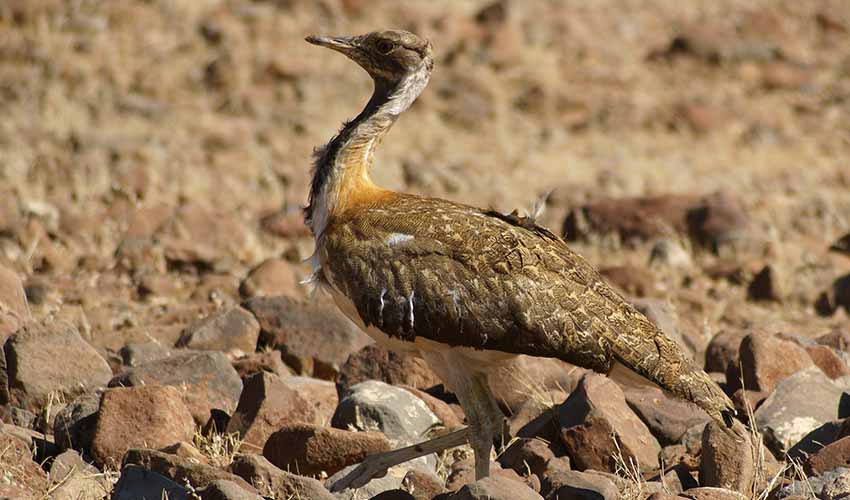
A large, ground-loving bird of southern Africa that looks like it was designed for wide open spaces. It lives mostly in dry grasslands and semi-desert areas, where the horizon feels endless, and cover is scarce. Instead of relying on speed or bright colors, Ludwig’s bustard depends on a smart mix of size, caution, and camouflage. Its feathers are mostly brown, buff, and gray, patterned in a way that blends beautifully with dry soil and scrubby plants. From far away, it can be surprisingly hard to spot, and when it stands still, it almost melts into the landscape.
What makes Ludwig’s bustard different from many other bustards is its overall “built for the plain” feel—big enough to deter some threats, but still streamlined enough to move steadily across long distances in search of food. It spends much of its day walking with a slow, deliberate pace, stopping often to scan the area. Bustards are known for being cautious, and Ludwig’s is no exception: it tends to avoid trouble rather than rush into flight. When it finally does take off, the effort is obvious. It often runs first to build up speed, then lifts with powerful wingbeats. The flight can look heavy at the start, but once airborne, it can travel well, especially when moving between feeding areas.
Ludwig’s bustard is also interesting because it is an adaptable eater, which helps it survive in tough environments. It feeds on a mix of things—plants, seeds, and especially insects when they’re available. In dry regions where food comes and goes with rain, being flexible is a huge advantage. After rains, insects can become abundant, and Ludwig’s bustards take full advantage, turning those short-lived bursts of life into energy for survival and breeding. Like many large ground birds, it is alert and uses its excellent eyesight to spot danger early, often choosing to walk away calmly rather than waste energy on panic.
Distribution
 Angola
 Botswana
 Lesotho
 Namibia
 South Africa
Anything we've missed?
Help us improve this page by suggesting edits. Glory never dies!
Suggest an editGet to know me
Terrestrial / Aquatic
Altricial / Precocial
Polygamous / Monogamous
Dimorphic (size) / Monomorphic
Active: Diurnal / Nocturnal
Social behavior: Solitary / Pack / Herd
Diet: Carnivore / Herbivore / Omnivore / Piscivorous / Insectivore
Migratory: Yes / No
Domesticated: Yes / No
Dangerous: Yes / No




