


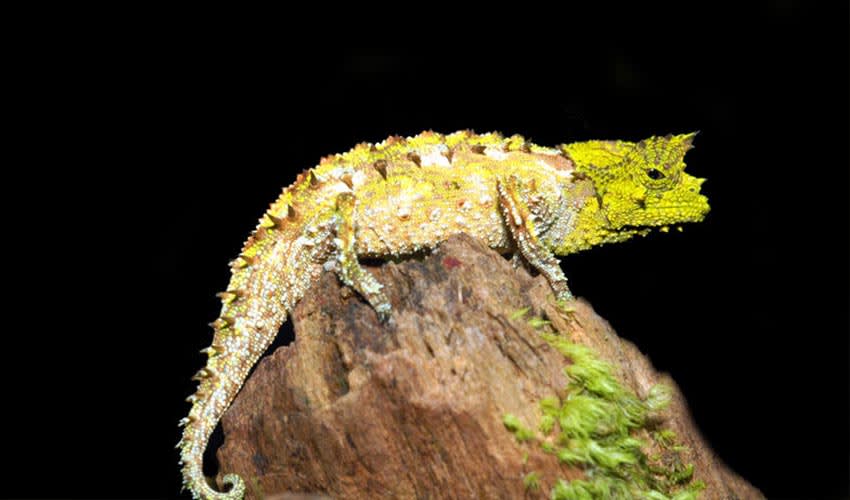
Found throughout the humid rainforests of eastern and northern Madagascar, the mossy pygmy leaf chameleon thrives on the forest floor, where it spends most of its life among fallen leaves, twigs, and moss. Its skin is mottled with shades of brown, green, gray, and even faint orange, often decorated with lichen-like markings that resemble patches of moss. Its body is slightly flattened and covered in tiny ridges and bumps, giving it the rough, uneven look of forest bark or decaying leaves.
Like other leaf chameleons, the mossy pygmy leaf chameleon spends its days moving slowly and deliberately through the undergrowth. It is an ambush predator, feeding on small insects, spiders, and other invertebrates that wander close. When hunting, it relies on stealth rather than speed—its long, sticky tongue shoots out in an instant to snatch unsuspecting prey. Although it doesn’t change colors as dramatically as larger, tree-dwelling chameleons, it can subtly shift its shades to better match its surroundings. During the day, it stays low to the ground, but at night it climbs onto small twigs or branches to sleep, often turning a lighter color to blend in with the moonlit forest.
Its camouflage is so effective that even experienced researchers can easily walk past one without noticing. When threatened, the mossy pygmy leaf chameleon’s first instinct is to freeze completely, becoming indistinguishable from the forest floor. It might flatten its body, curl its tail, and lower its head to mimic a dead leaf or clump of moss. This behavior, combined with its textured skin and subtle color patterns, makes it nearly invisible to predators like birds and larger reptiles. Despite its cryptic nature, this chameleon is surprisingly bold for its size and will sometimes perform small threat displays by opening its mouth or puffing up slightly to look larger.
Distribution
 Madagascar
Anything we've missed?
Help us improve this page by suggesting edits. Glory never dies!
Suggest an editGet to know me
Terrestrial / Aquatic
Altricial / Precocial
Polygamous / Monogamous
Dimorphic (size) / Monomorphic
Active: Diurnal / Nocturnal
Social behavior: Solitary / Pack / Herd
Diet: Carnivore / Herbivore / Omnivore / Piscivorous / Insectivore
Migratory: Yes / No
Domesticated: Yes / No
Dangerous: Yes / No




