


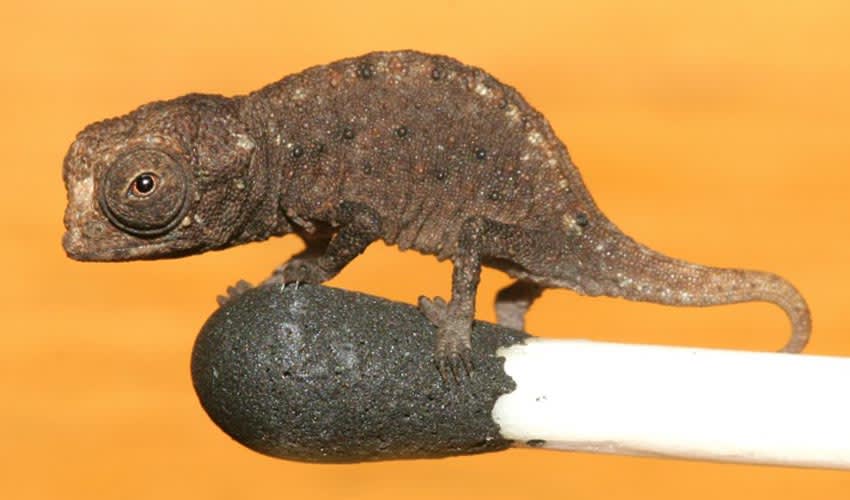
A reptile so tiny it could stand comfortably on the tip of your finger. Endemic to the Nosy Hara islet, a small limestone island off the northern coast of Madagascar, this miniature chameleon is one of the smallest reptiles ever discovered. Yet despite its size, the Nosy Hara leaf chameleon is perfectly equipped for life in its miniature world—a living example of evolution at its most precise and astonishing.
This species was discovered in 2012, and its discovery stunned scientists. Living among the leaf litter, moss, and limestone crevices of Nosy Hara’s dry forests, the chameleon’s tiny body is a masterpiece of adaptation. It has a compact, slightly flattened build, colored in shades of earthy brown, gray, and orange, allowing it to blend flawlessly into the forest floor. During the day, it hides among fallen leaves and under stones; at night, it climbs onto low twigs or grass stems, just a few centimeters above the ground, to sleep safely away from ground-dwelling predators. Despite its minuscule size, it behaves like its larger relatives—rotating its eyes independently, shooting out a sticky tongue nearly as long as its body to catch tiny insects, and moving with the slow, deliberate grace characteristic of chameleons.
The Nosy Hara leaf chameleon’s tiny scale is its greatest strength. It requires very little food or space and can exploit microhabitats that larger animals can’t. It feeds mostly on minute insects and arthropods, invisible to most predators, and its camouflage is nearly perfect—so much so that even experienced researchers struggle to find it in the wild. However, this same specialization makes it vulnerable. The species is micro-endemic, found only on Nosy Hara, meaning that any damage to its fragile habitat—whether from deforestation, invasive species, or human activity—poses a serious threat to its survival. Protecting its limestone forest home is critical to ensuring this remarkable chameleon’s continued existence.
Distribution
 Madagascar
Anything we've missed?
Help us improve this page by suggesting edits. Glory never dies!
Suggest an editGet to know me
Terrestrial / Aquatic
Altricial / Precocial
Polygamous / Monogamous
Dimorphic (size) / Monomorphic
Active: Diurnal / Nocturnal
Social behavior: Solitary / Pack / Herd
Diet: Carnivore / Herbivore / Omnivore / Piscivorous / Insectivore
Migratory: Yes / No
Domesticated: Yes / No
Dangerous: Yes / No




