


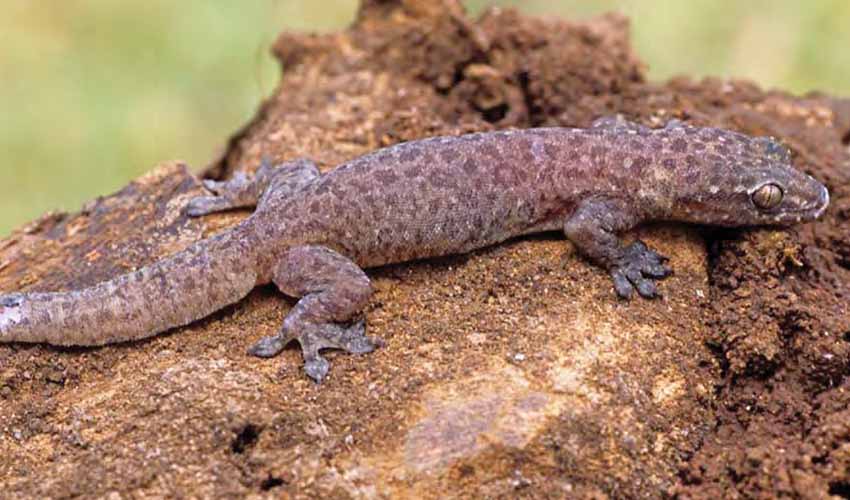
Found across Southeast Asia, parts of the Pacific Islands, and even introduced populations in places like Hawaii and Australia, this adaptable gecko has earned a reputation for being both a stealthy houseguest and a resilient survivor. Its name comes from its distinctive blunt, “stumpy” toe tips, which make it look as if its toes have been trimmed—an unusual feature that gives it both its scientific name (mutilata, meaning “maimed”) and its common one.
The stump-toed gecko is medium-sized for a gecko. Its body is smooth and slightly translucent, often showing hints of pink or gray, with darker mottling that helps it blend into walls, bark, and stones. At night, under artificial light, you can sometimes see the faint glow of its internal organs through its thin skin—a quirky trait that adds to its ghostly appearance. Its toes are equipped with specialized adhesive pads, allowing it to climb effortlessly on vertical surfaces, including glass, walls, and ceilings. Unlike some geckos with prominent claws, this species has reduced claws and rounded toe ends, making its feet look oddly “cut off” or swollen—hence its name.
This gecko is a nocturnal insectivore, emerging after sunset to hunt small insects, spiders, and other invertebrates. In urban areas, it often patrols walls near lights, taking advantage of the insects drawn there—a natural pest controller that quietly coexists with humans. During the day, it hides in cracks, under bark, or behind wall fixtures, avoiding heat and predators. Like many geckos, it can drop its tail when threatened—a defense mechanism that distracts predators while the gecko escapes. The tail later regenerates, though it is usually shorter and differently shaped than the original.
What makes the stump-toed gecko especially interesting is its adaptability. It thrives in both wild and human-modified environments, from tropical forests to city apartments. It’s also parthenogenetic in some populations, meaning females can reproduce without males—an evolutionary advantage that allows the species to colonize new areas rapidly.
Distribution
 American Samoa
 Australia
 Bangladesh
 Brunei
 Cambodia
 China
China Christmas Island
 Cocos Is. (Keeling)
 Cook Islands
 East Timor
 Fiji
Fiji France
 French Polynesia
 Guam
Guam Hong Kong
 India
India Indonesia
 Japan
Japan Kiribati
 Laos
Laos Madagascar
 Malaysia
 Mauritius
 Mexico
 Micronesia
 Myanmar
 Nort. Mariana Is.
 Palau
Palau Papua New Guinea
 Philippines
 Pitcairn
 Samoa
Samoa Seychelles
 Singapore
 Solomon Islands
 Sri Lanka
 Taiwan
 Thailand
 Tonga
Tonga US Minor Is.
 United States
 Vanuatu
 Vietnam
Anything we've missed?
Help us improve this page by suggesting edits. Glory never dies!
Suggest an editGet to know me
Terrestrial / Aquatic
Altricial / Precocial
Polygamous / Monogamous
Dimorphic (size) / Monomorphic
Active: Diurnal / Nocturnal
Social behavior: Solitary / Pack / Herd
Diet: Carnivore / Herbivore / Omnivore / Piscivorous / Insectivore
Migratory: Yes / No
Domesticated: Yes / No
Dangerous: Yes / No




