


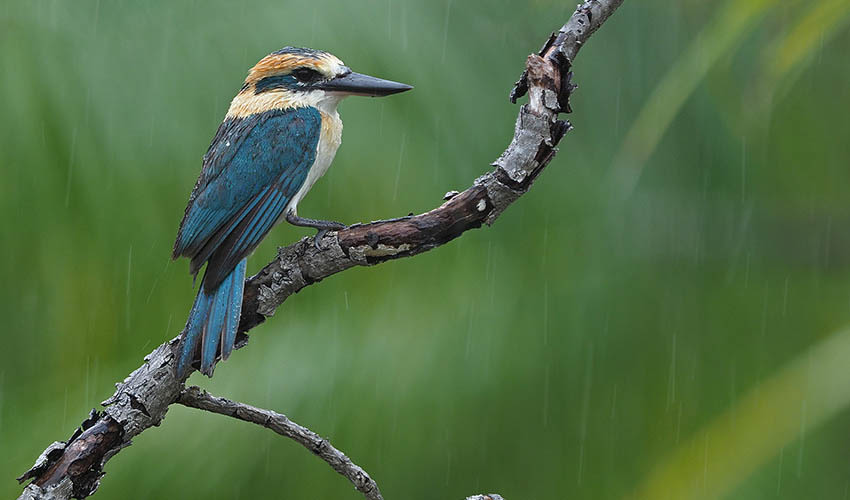
One of the most imperiled and geographically restricted kingfishers on Earth, found only on a handful of low-lying atolls in the Tuamotu Archipelago of French Polynesia. Once widespread across several islands, it has now been reduced to a single surviving natural population, making it a conservation priority. This striking bird is medium-sized with a bright white belly, rich rufous or chestnut tones on the head and flanks, and shimmering blue wings and back that catch the light beautifully. Its sturdy bill, typical of forest kingfishers, is built for snatching insects, small lizards, and crustaceans rather than catching fish.
The Tuamotu kingfisher inhabits coconut groves, coastal scrublands, and forest patches on coral atolls — fragile ecosystems shaped by salt spray, shifting sands, and limited freshwater. Unlike river or mangrove kingfishers, this species often perches on exposed branches, fence posts, or palms, scanning for prey with quick, darting movements. It hunts primarily by sallying: flying out to grab insects in the air or pouncing on ground prey before returning to its perch. Its diet includes crickets, beetles, moths, geckos, and occasionally small crabs, making it an important controller of invertebrates on these isolated islands.
Breeding takes place in tree cavities, coconut palms, or dead trunks softened by decay. Because natural nesting sites are limited on low coral islands, competition for suitable cavities can be intense. Pairs are monogamous and strongly territorial, defending their patch of forest vigorously. They typically raise a small clutch of two to three chicks, and parental care is highly cooperative — both adults share in feeding and protection. Chicks fledge after several weeks but may remain near their parents’ territory while learning to hunt.
Distribution
 French Polynesia
 Official estimate
Anything we've missed?
Help us improve this page by suggesting edits. Glory never dies!
Suggest an editGet to know me
Terrestrial / Aquatic
Altricial / Precocial
Polygamous / Monogamous
Dimorphic (size) / Monomorphic
Active: Diurnal / Nocturnal
Social behavior: Solitary / Pack / Herd
Diet: Carnivore / Herbivore / Omnivore / Piscivorous / Insectivore
Migratory: Yes / No
Domesticated: Yes / No
Dangerous: Yes / No




